


Jimbaran Bay Beach & Seafood Coast
Teluk pasir emas seluas empat kilometer yang tenang dan terlindung, termasyhur di dunia dengan jamuan makan malam hidangan laut bakar arang batok kelapa beralaskan pasir berhias cahaya lilin saat senja.
📜 Latar Belakang Sejarah & Makna Budaya
Pusat perkampungan nelayan tradisional tertua di Bali selatan yang bertransformasi sejak era 1990-an menjadi ikon kuliner pesisir tanpa meninggalkan tradisi melaut dan lelang ikan segar di Kedonganan.
Tarif Resmi Tiket Masuk
| Kategori Pengunjung | Tarif Resmi (IDR) | Est. (USD) | Inklusi & Catatan |
|---|---|---|---|
| Domestic / WNI (Adult) | IDR 0 | $0.00 | Free access |
| Domestic / WNI (Child) | IDR 0 | $0.00 | Free access |
| Foreign Tourist (Adult) | IDR 0 | $0.00 | Free public beach access; IDR 2k-5k parking fee |
| Foreign Tourist (Child) | IDR 0 | $0.00 | Free access |
Etika Budaya Bali & Hukum Adat Awig-Awig
Pedoman resmi adat desa dan tata tertib tempat suci untuk Jimbaran Bay Beach & Seafood Coast.
Pakaian santai resor, busana renang saat siang hari, dan sandal kasual yang nyaman untuk bersantap santai di hamparan pasir pantai pada malam hari.
Awig-Awig Desa Adat Jimbaran: wajib menjaga kebersihan pantai; berikan prioritas kepada nelayan lokal saat menarik jaring dan melabuhkan perahu; dilarang mengoperasikan olahraga air bermesin di zona renang aman.
Zona Terlarang Terbang Ketat. ZONA LARANGAN TERBANG KETAT: berada langsung di bawah jalur lintasan lepas landas dan pendaratan Bandara Internasional Ngurah Rai; penerbangan drone dilarang keras oleh otoritas penerbangan sipil.
Sepeda Motor: IDR 2.000
Mobil Penumpang: IDR 5.000
Transportation & Access Radar
Grab and Gojek operate freely for drop-off and pickup along the entire beach road.
Calm, gentle shorebreak safe for family swimming at all tides; low tide creates vast firm sand expanse; sunset is prime time for candlelit beach seafood dinners.
Always verify seafood prices per 100 grams before ordering and watch the scale being zeroed at warungs.
Radar Elevasi & Aksesibilitas
Navigasi & Transit
Sorotan Visual & Arsitektur (7 Foto)
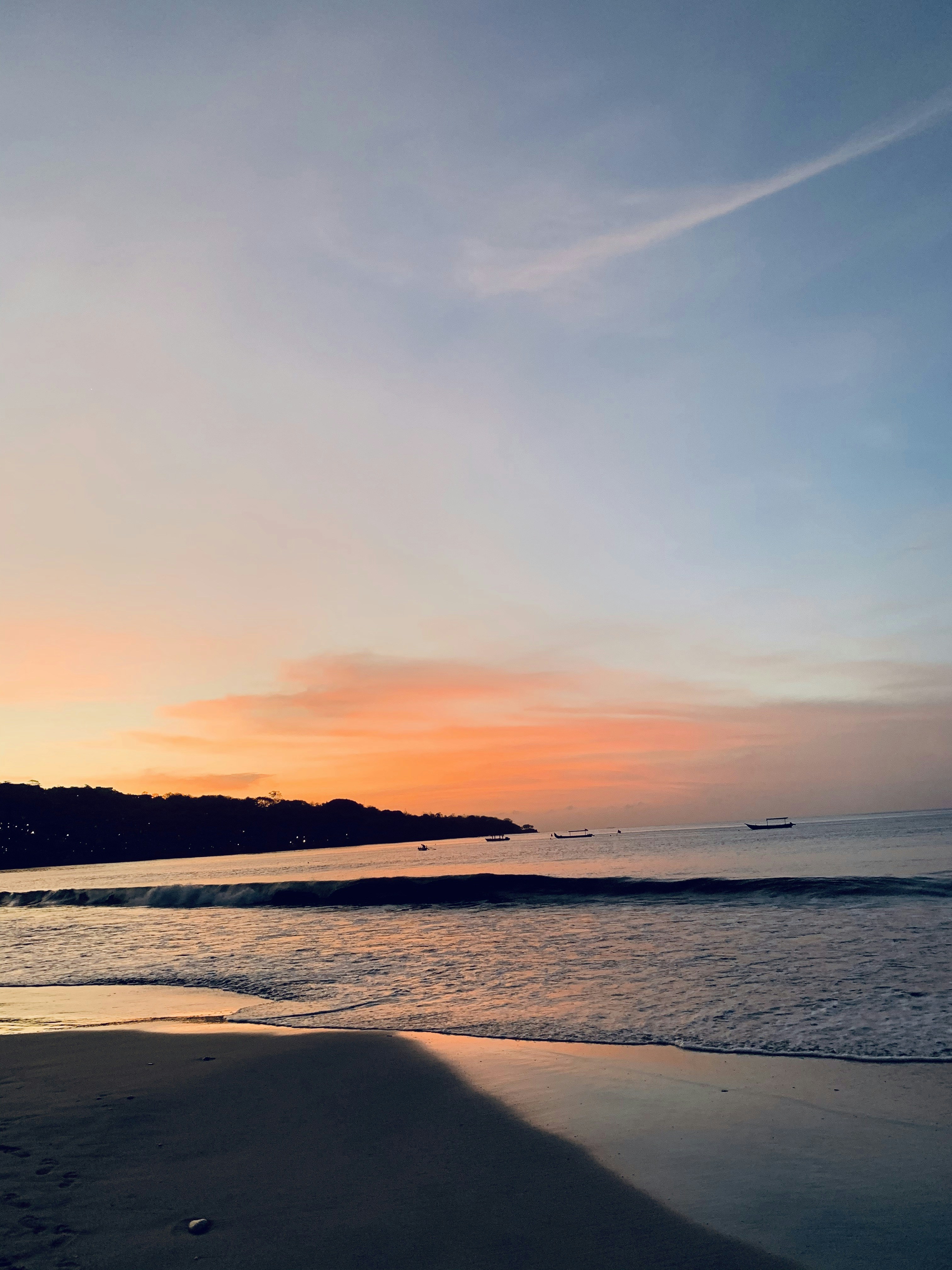
Jimbaran Bay Beach & Seafood Coast — Sweeping golden sand crescent stretching along the protected bay, with calm waters and distant airport runway peninsula.
Photo: Marten Bjork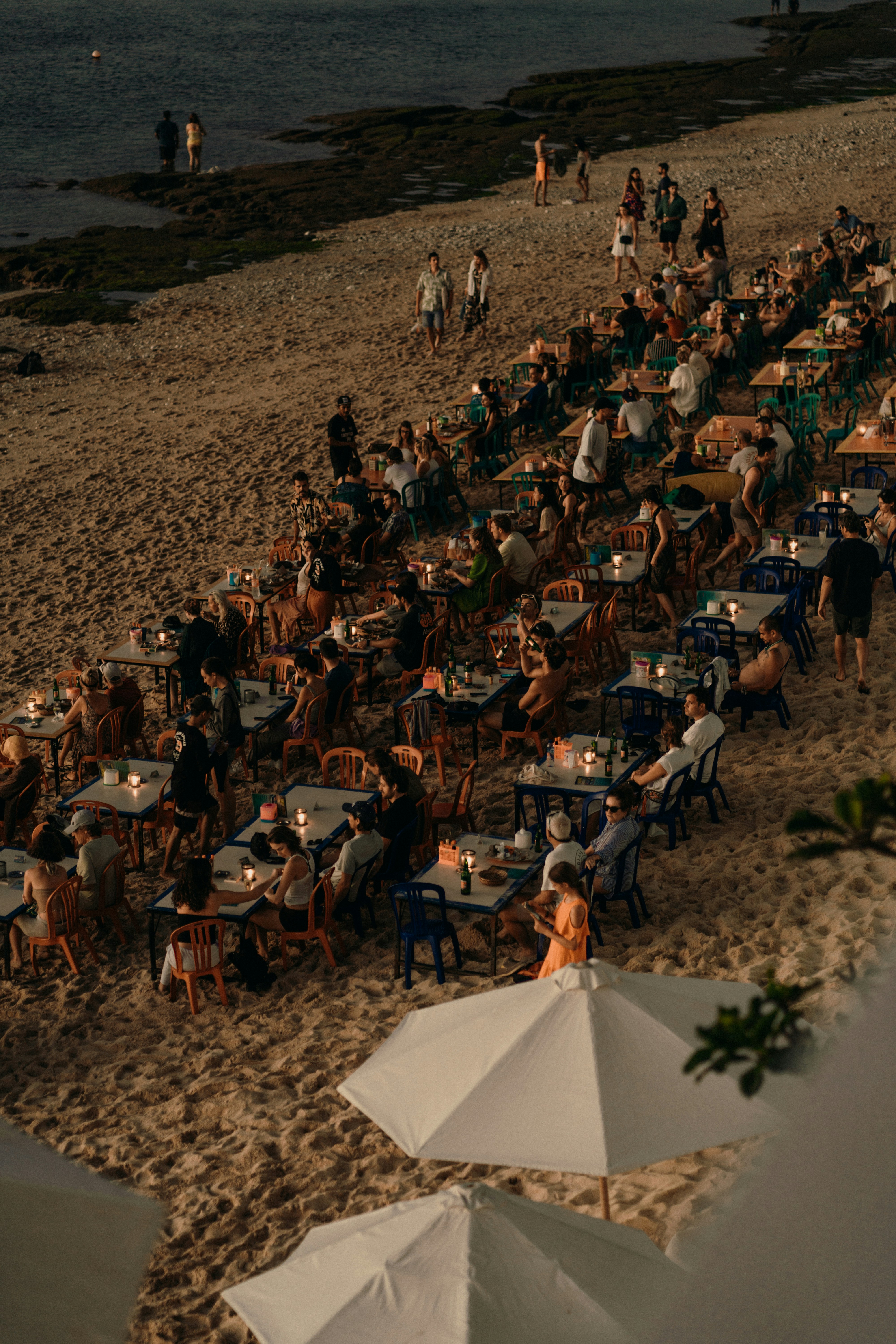
Jimbaran Bay Beach & Seafood Coast — Candlelit dining tables arranged directly upon the sand outside the iconic beachside seafood warungs at dusk.
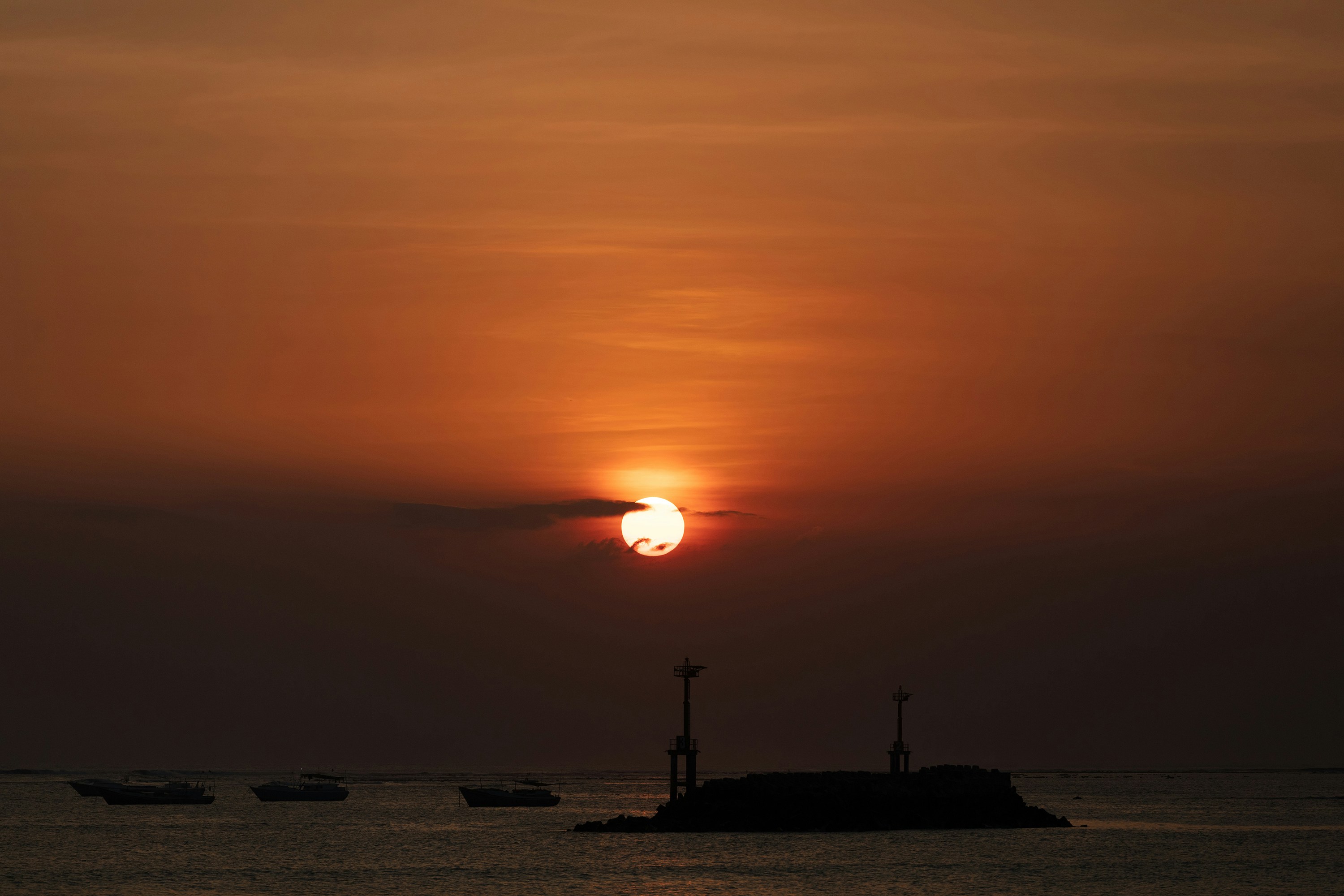
Jimbaran Bay Beach & Seafood Coast — Traditional Balinese outrigger jukung fishing boats resting on the tranquil bay waters as sunset approaches.
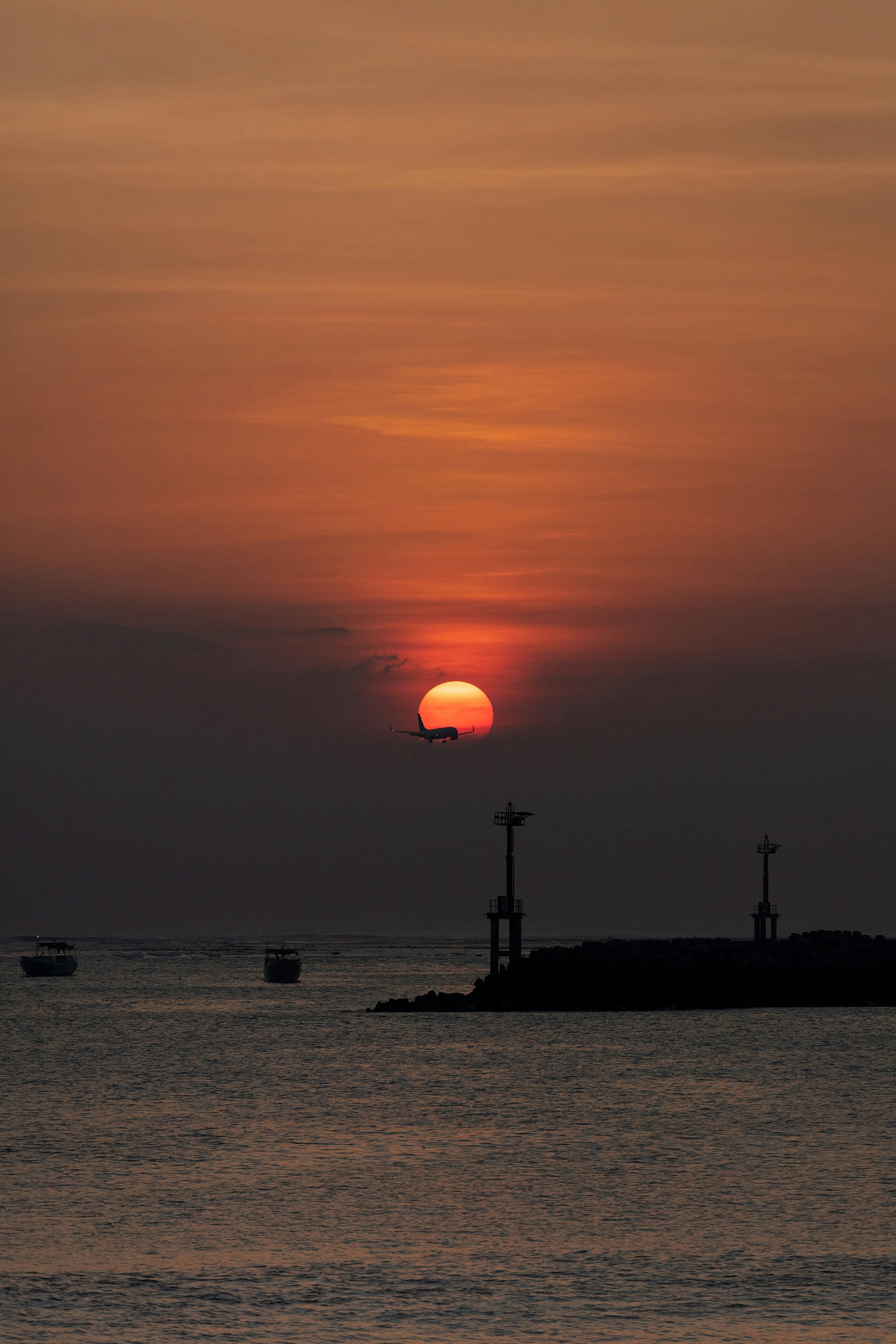
Jimbaran Bay Beach & Seafood Coast — Spectacular sunset illumination casting warm golden and amber tones across the broad western ocean horizon.

Jimbaran Bay Beach & Seafood Coast — Evening ambiance along the sand with glowing yellow lantern lights, red umbrellas, and wafting aroma of grilled seafood.
Panduan Budaya, Sejarah & Arsitektur
Comprehensive Cultural Guide: Jimbaran Bay Beach & Seafood Coast
1. Comprehensive Overview & Cultural Significance
Jimbaran Bay Beach stands as one of Bali's most iconic and evocative coastal sanctuaries—a magnificent four-kilometre crescent of golden sand where traditional fishing heritage seamlessly converges with world-renowned seaside gastronomy. Situated along the sheltered western neck connecting the mainland to the Bukit Peninsula in Badung Regency, this expansive bay offers an extraordinary alternative to the turbulent surf breaks of southern Bali. Renowned globally for its nightly candlelit seafood feasts set directly upon the sand, Jimbaran represents far more than an evening dining destination; it is a thriving, multi-generational fishing community that has guarded its maritime customs, communal boat-building guilds, and ocean temples across centuries of rapid modern change.
By day, Jimbaran Bay presents an idyllic, tranquil panorama of calm azure waters, gently rolling waves, and traditional hand-carved outrigger canoes (jukung) resting gracefully along the high-tide line. Families, distance swimmers, and long-walk enthusiasts revel in the wide, level sandy concourse that remains pleasantly walkable at virtually all hours. As late afternoon approaches, the bay transforms into an open-air amphitheater for one of the most celebrated sunset spectacles in Southeast Asia. The sky erupts in shades of molten gold, magenta, and deep indigo, while beachfront warungs ignite thousands of coconut-husk barbecues, filling the coastal breeze with the intoxicating, smoky aroma of grilled red snapper, jumbo prawns, and fresh squid glazed in fiery Balinese spices.
Crucially, the commercial success of Jimbaran's beachfront dining is governed directly by the customary village council (Desa Adat Jimbaran). Rather than allowing international conglomerates to privatize the shoreline, the community retains collective ownership of the coastal strip, ensuring that the economic fruits of tourism flow directly to local fishing households, market vendors, and culinary artisans. For travelers seeking an authentic encounter with Bali's living coastal culture, Jimbaran Bay delivers a profound sensory immersion that honors the eternal bond between the Balinese people and the generous, sacred ocean.
2. Exact Geographic Positioning & Micro-Terrain
Jimbaran Bay is located at coordinates -8.7750° S latitude, 115.1667° E longitude, situated within the administrative district of Kuta Selatan, Badung Regency. The bay spans approximately four kilometres between the Kedonganan fish market to the north and the towering limestone cliffs of the Bukit Peninsula near Four Seasons Resort to the south. Geographically, it occupies the western flank of the low-lying isthmus connecting mainland Bali to the Bukit plateau, resting at an average elevation of one to three metres above mean sea level.
The physical terrain of Jimbaran is exceptionally gentle and accessible. Unlike the cliff-bound beaches of Pecatu that require grueling stair descents, Jimbaran offers direct, zero-step access from flat coastal access roads, paved parking aprons, and open beachfront boulevards. The sand is golden, fine-grained, and deeply packed along the intertidal zone, making it exceptionally comfortable for barefoot strolls, jogging, and stroller navigation. The seabed slopes at a very gentle gradient into the bay, completely free of sharp volcanic coral heads or hazardous drop-offs in the primary swimming areas.
The physical difficulty level for visiting Jimbaran Bay is rated as EASY. It is fully accessible to elderly travelers, small children, and individuals with limited physical mobility. The northern sector near Kedonganan features bustling boat-launching ramps and working fish market docks, while the central and southern sectors (Muaya Beach) feature expansive sandy dining zones and polished resort pathways.
3. Mythological Genesis & Sacred Lore
According to Balinese Hindu oral literature and ancestral genealogies (babad), Jimbaran Bay was consecrated under the divine guardianship of Bhatara Baruna, the supreme cosmic deity who presides over the world's oceans and governs the fertility of marine life. In the traditional Balinese spatial cosmology of Kaja-Kelod (mountainward versus seaward), Jimbaran represents a vital Kelod threshold where the human community must continuously pay homage to the powerful spirits of the deep to maintain cosmic equilibrium (Tri Hita Karana).
At the southern curved arm of the bay stands Pura Ulun Siwi, a revered 18th-century temple founded during the reign of the Mengwi Kingdom. Unlike typical sea temples (Pura Segara), Pura Ulun Siwi is consecrated to Lord Shiva and is unique in that farmers from across Bali journey here to pray for divine protection against agricultural pests, believing that the spiritual energy radiating from this coastal nexus holds the power to purify the land of destructive blights. This profound interplay between oceanic sanctity and terrestrial fertility reinforces Jimbaran's stature as a spiritual keystone in southern Bali's temple network.
Throughout the year, especially during the auspicious full moon (Purnama) and the sacred purification ceremonies of Melasti preceding the Balinese Day of Silence (Nyepi), Jimbaran Bay becomes the ceremonial staging ground for thousands of white-clad Hindu devotees. Processions bearing sacred temple heirlooms (pratima) wind down to the water's edge, where high priests (pedanda) chant sacred Sanskrit mantras, ring bronze bells, and cast ceremonial offerings into the surf to cleanse the physical and metaphysical realm of impurities accumulated over the year.
4. Chronicle of Fishermen Guilds & the Culinary Revolution
For centuries, Jimbaran was a modest, self-contained fishing village isolated from the royal courts of Denpasar and Klungkung by dense mangrove forests and arid limestone scrub. The daily life of the settlement was structured around the Sekehe Jukung, hereditary fishing cooperatives where master fishermen passed down intricate navigational lore, wind reading techniques, and star navigation across generations. Each dawn, hundreds of colorful outrigger canoes would ride the offshore breezes into the deep currents of the Bali Strait, returning at midday with holds filled with seasonal catches.
The pivotal transformation of Jimbaran began in the 1980s. When modern development began creeping south from Kuta, village elders and visionary community leaders recognized that the traditional fishing trade alone could no longer sustain the growing population. However, instead of selling ancestral beachfront land to foreign resort developers, the village conceived a revolutionary community-based enterprise: the beachfront seafood clusters. Local fishing families set up humble wooden tables on the sand, grilling their daily catch over open pits fueled by dried coconut shells—an abundant, sustainable agricultural byproduct that imparted an unmistakable sweet, smoky flavor to the fish.
What began as a collection of rustic, kerosene-lantern-lit shacks quickly gained an international reputation among intrepid food lovers and travel writers. Over the subsequent decades, the village formalized these dining clusters into three organized beachfront precincts: Kedonganan to the north, Pantai Muaya in the center, and the southern bay strip. Today, while luxurious international resorts line the clifftops and garden perimeters, the sands themselves remain the proud domain of the local village cooperative, providing sustainable livelihoods to over two thousand local families and preserving the living soul of Balinese coastal hospitality.
5. Architectural Anatomy & Harbor Heritage
The architectural landscape of Jimbaran Bay is defined by its harmonious coexistence of traditional marine engineering and unpretentious beachfront dining structures. The primary traditional architectural element is the Jukung outrigger canoe itself—an exquisite example of indigenous naval architecture. Carved from hollowed camphor or jackfruit logs, the hull is slender and hydrodynamically efficient, equipped with twin outriggers fashioned from arched bamboo poles (katir) lashed with durable coconut-fiber cords. Painted in vibrant polychrome patterns featuring sacred eyes (gajah mina) on the bow to guide fishermen through dark waters, these boats line the shoreline like a living, open-air maritime exhibition.
Along the upper sandy terrace sit the clusters of seafood warungs, designed using traditional open-air Balinese pavilion (bale) architecture. Constructed from local bamboo, thatched alang-alang grass, and sturdy teak timbers, these pavilions are open on all four sides to allow the cool evening sea breezes (angin laut) to circulate freely. In front of each warung, outdoor dining tables are arranged directly upon the firm white sand, illuminated by glowing candles nestled inside hurricane lamps and the warm orange embers of open grilling hearths.
At the northern harbor in Kedonganan, the architectural focus shifts to practical maritime commerce. Here, an elevated wooden auction pier, ice-crushing facilities, and the bustling central fish market showcase the vibrant, gritty reality of commercial Balinese fishing. Freshly landed swordfish, yellowfin tuna, mahi-mahi, king crab, and giant tiger prawns are unloaded directly from incoming vessels, offering visitors a fascinating glimpse into the supply chain that supplies top restaurants across the island.
6. Essential Etiquette, Awig-Awig & Coastal Regulations
To ensure a safe and respectful visit to Jimbaran Bay, travelers should observe traditional coastal etiquette and local customary bylaws (awig-awig):
- Aviation Drone Restrictions: Jimbaran Bay lies directly underneath the northern and western flight approaches of I Gusti Ngurah Rai International Airport (DPS). Flying unmanned aerial vehicles (drones) anywhere within Jimbaran Bay is strictly prohibited by Indonesian civil aviation law without prior military and airport authority clearance. Violations carry severe fines and equipment confiscation.
- Beachfront Dress Standards: While standard swimwear and beach attire are entirely acceptable on the sand and in the water during daytime hours, visitors should dress in casual, respectful resort wear (shirts, shorts, summer dresses) when dining at evening seafood restaurants or walking along village access roads. Topless sunbathing is strictly forbidden under Balinese customary law.
- Respect for Active Fishermen: The shoreline remains an active, working fishing harbor. Always grant right-of-way to fishing crews launching or beaching their heavy wooden jukung boats, and do not handle fishing nets, lines, or gear drying along the upper sand berms without permission.
- Ceremonial Boundaries: When encountering Melasti or coastal Hindu ceremonies on the beach, maintain a respectful viewing distance (at least 10 metres). Never walk between the officiating priests (pemangku) and the ocean, and refrain from using blinding flash photography during sacred prayers.
7. Practical Logistics & Tidal Considerations
Planning a visit to Jimbaran Bay is straightforward thanks to its central location and excellent infrastructure:
- Optimal Time to Visit: The absolute prime window is 16:30 to 20:30. Arriving by 16:30 allows ample time to enjoy a relaxing afternoon swim in calm waters, photograph the colorful fishing fleet, and secure a prime frontline table on the sand before the sunset show begins at approximately 17:45 to 18:15.
- Transportation & Ride-Hailing: Jimbaran is exceptionally friendly to ride-hailing services. Grab and Gojek operate freely throughout the entire coastal strip, with dedicated pickup points and zero local taxi cartel restrictions. A ride from Seminyak or Canggu takes 45 to 75 minutes depending on traffic; from Nusa Dua or Uluwatu, expect 20 to 35 minutes.
- Tidal Dynamics: Jimbaran Bay is safe for swimming across virtually all tidal ranges. Low tide exposes a broad, firm sandy terrace ideal for beach walking and family beach games; high tide brings calm, deep water right up to the warung seating perimeter. Even during peak spring tides, ocean surges rarely pose a danger within the sheltered bay.
- Weather & Seasonality: The dry season (May to October) brings clear twilight skies, gentle east-southeast trade winds, and postcard-perfect sunsets. During the wet season (December to February), western monsoonal swells occasionally deposit seasonal flotsam on the sand, which is cleared promptly by daily municipal and village beach-cleaning crews.
8. Entry Tariffs & Transparent Inclusions
Jimbaran Bay maintains an open public access policy, welcoming all visitors without mandatory admission charges:
- Foreign Adult Entry: IDR 0 (Free Public Access)
- Foreign Child Entry: IDR 0 (Free Public Access)
- Domestic Adult Entry: IDR 0 (Free Public Access)
- Domestic Child Entry: IDR 0 (Free Public Access)
- Vehicle Parking Fees:
- Scooters and Motorcycles: IDR 2,000 to IDR 5,000 per vehicle.
- Cars and Passenger Vans: IDR 5,000 to IDR 10,000 per vehicle.
- Parking fees are collected at official village-managed barrier gates and fund local security (pecalang), beachfront illumination, and daily waste collection.
- Seafood Dining Economics: Fresh seafood at the beachfront warungs is charged by weight (per 100 grams or per kilogram) rather than fixed menu portions. Standard dining packages typically include complimentary steamed rice, stir-fried water spinach (plecing kangkung), fresh fruit, and a variety of homemade Balinese dipping sambals (sambal matah, sambal mbe, sweet soy chili).
9. Sustainable Tourism & Marine Stewardship
With thousands of dinners served on the sands of Jimbaran each evening, environmental stewardship is essential to preserving the beauty and ecological vitality of the bay:
- Zero Plastic Policy on the Sand: Avoid bringing single-use plastic cups, straws, or bags down to the water. The bay's calm waters can easily sweep discarded plastic into nearshore marine habitats, endangering sea turtles and coastal fish populations.
- Responsible Seafood Selection: Support sustainable fishing practices by selecting mature fish, farm-raised tiger prawns, and responsibly harvested shellfish. Avoid purchasing undersized juvenile lobsters or rare reef species.
- Fair Seafood Weighing Practices: To avoid billing misunderstandings, always accompany the restaurant staff to the live seafood display tanks and personally verify the raw weight of your selected fish and shellfish on the scale before it is sent to the coconut-husk grill.
- Empowering Local Cooperatives: By choosing to dine at the independent, family-owned warungs along Pantai Muaya and Kedonganan rather than closed luxury hotel buffets, your travel spending directly supports local boat owners, fish market stallholders, and generational Balinese hospitality workers.
Maritime Lore, Sacred Fishermen Guilds & the Twilight Fires of Jimbaran Bay
Jimbaran Bay—stretching as a graceful four-kilometre concave crescent of golden sand along Bali's southwestern neck—is steeped in an ancient maritime heritage that bridges the pre-Majapahit era with the island's most evocative culinary tradition. In the cosmological mapping of the Balinese Hindu cosmos (Dewata Nawa Sanga), the bay occupies the sacred threshold of Segara, the realm of Bhatara Baruna, lord of the celestial and oceanic depths. Long before international travelers sat before candlelit tables on the shoreline, Jimbaran was an insulated cluster of traditional fishing hamlets (Desa Adat Jimbaran) whose existence was governed entirely by the rhythms of the Indian Ocean swell, the monsoonal wind shifts, and the sacred ceremonies of coastal purification.
Local chronicles preserved in palm-leaf manuscripts (lontar) recount that the coastal waters off Jimbaran were regarded as a vital protective perimeter guarding the sacred Bukit Peninsula from oceanic malevolence. The village fishermen, organised into tight-knit hereditary cooperative guilds (sekehe jukung), operated under strict customary bylaws (awig-awig) that mandated sustainable net-casting, communal catch-sharing, and regular ocean appeasement offerings (Pakelem). Before launching their hand-carved outrigger canoes (jukung) into the twilight surf, crews would gather at beachside shrines (Pura Segara Jimbaran) to lay woven palm offerings of betel nut, sea salt, and holy water, seeking protection from sudden rip currents and divine guidance toward the rich tuna, snapper, and mackerel feeding grounds of the Bali Strait.
The cultural evolution of Jimbaran took a historic turn in the late twentieth century. While neighboring Kuta succumbed to high-density commercial tourism, the elders of Desa Adat Jimbaran made a conscious decision to preserve the authentic artisanal character of their coastline. The village permitted local fishing families to establish open-air beachfront grilling warungs directly on the sand, cooking the day's freshly landed catch over smoking coconut husks (sabut kelapa) seasoned with secret heirloom spice pastes (bumbu Bali). This fusion of artisanal fishing culture with seaside hospitality transformed Jimbaran into an internationally revered symbol of Balinese coastal living. Today, as the sun dips beneath the western ocean horizon and thousands of coconut-husk ember fires flicker across the sands, the scene remains an unbroken sensory continuation of a community whose heart belongs inextricably to the sea.
Coastal Morphology, Protected Bay Mechanics & the Geology of Jimbaran Bay
Geologically, Jimbaran Bay represents one of Bali's most sheltered coastal formations—a natural sweeping embayment formed at the low-lying isthmus that connects the volcanic mainland of Bali to the elevated limestone plateau of the Bukit Peninsula. Unlike the exposed, wave-battered limestone cliffs of Uluwatu or the dynamic black sand beaches of the southwest coast, Jimbaran Bay is cradled within a wide, southwest-facing crescent flanked to the south by the high bluffs of Bukit and to the north by the coral reefs of Tuban and Ngurah Rai. This unique physical configuration acts as a giant natural energy dissipator, muting the ferocious swells that roll out of the deep Southern Ocean and creating an unusually calm, swimmable maritime sanctuary.
The beach itself is composed of deep, golden-white quartzose and calcareous sand, washed fine by gentle, persistent longshore currents. Because the nearshore bathymetry features an exceptionally wide and gently sloping continental shelf, the waves break far offshore across outer sandbars, allowing the intertidal zone to remain tranquil and remarkably safe for swimmers of all experience levels. At low tide, the receding waters expose a vast sandy apron extending over one hundred metres seaward, creating reflective tide pools that mirror the dramatic sunset skies with mirror-like clarity. At high tide, the water rises smoothly without generating the hazardous shorebreaks or violent backwashes typical of steeper cliff-flanked beaches.
At the northern extremity of the bay lies the historic fishing harbor of Kedonganan, where the shallow coastal shelf provides safe anchorage for hundreds of vibrantly painted wooden jukung outrigger boats. These vessels, constructed from buoyant local timber and stabilized with dual bamboo outriggers, are engineered with hydrodynamic hull forms that have remained essentially unchanged for centuries. Near the southern headland, the coastline rises abruptly into the porous Pleistocene limestone strata of the Bukit formation, displaying karstic crevices, fossilized coral colonies, and natural overhangs that frame the luxury clifftop estates above. This dramatic transition from gentle sandy shelf to vertical limestone barrier showcases the extraordinary geological diversity of Bali's southern coast within a single continuous vista.
Frequently Asked Questions & Local Logistics
Key logistical insights, official tariffs, and customary etiquette for Jimbaran Bay Beach & Seafood Coast.
Top Curated Stays Near Jimbaran Bay Beach & Seafood Coast
Akomodasi terkurasi dalam radius 8 km, diurutkan berdasarkan ulasan wisatawan dan waktu tempuh tercepat.

InterContinental Bali Resort By IHG

Movenpick Resort & Spa Jimbaran Bali

Four Seasons Resort Bali at Jimbaran Bay

Kayumanis Jimbaran Private Villas & Spa
Aktivitas Terkurasi Dekat Jimbaran Bay Beach & Seafood Coast
Curated guided tours and local adventures operated within easy transit of this landmark.

Jimbaran Bay Traditional Jukung Sunset Sailing Cruise
Sail across gentle Jimbaran waters in a handcrafted wooden outrigger as the sun sets.

Guided South Bali Cliff Trail & Hidden Cove Trek
Curated Balinese experience: Guided South Bali Cliff Trail & Hidden Cove Trek. Part of Bali Expert Guide's signature curated journeys.

Kedonganan Seafood Market Guided Dawn Tour & Grill Masterclass
Select fresh catches with village fishermen and master Balinese sambal matah grilling techniques.