


Pura Rambut Siwi
The premier cliffside sea temple of Western Bali, dramatically perched atop black sand ocean bluffs with sweeping vistas across the Indian Ocean toward East Java.
📜 Historical Context & Significance
Founded in the 16th century by holy sage Dang Hyang Nirartha, who left a lock of his sacred hair (Rambut Siwi) to bestow divine protection upon travelers and the surrounding realm.
Official Entry Ticket Rates
| Visitor Category | Official Rate (IDR) | Est. (USD) | Inclusions & Notes |
|---|---|---|---|
| Domestic / WNI (Adult) | IDR 20.000 | $1.13 | WNI Adult |
| Domestic / WNI (Child) | IDR 10.000 | $0.56 | WNI Child |
| Foreign Tourist (Adult) | IDR 40.000 | $2.25 | Includes complimentary yellow waist sash loan and access to coastal cliff shrines |
| Foreign Tourist (Child) | IDR 20.000 | $1.13 | Child admission ages 5-11 |
Balinese Cultural Etiquette & Awig-Awig Bylaws
Official village adat guidelines and sacred site protocol for Pura Rambut Siwi.
Traditional Balinese sarong (kamen) and waist sash (selendang) required. ✓ Kain sarong and yellow sash mandatory for entry.
Desa Adat Yeh Embang Kangin bylaws enforce strict cuntaka bans. The inner sanctum enshrining Dang Hyang Nirartha's relic is accessible only to praying devotees. ⚠️ Per Balinese Hindu theology, menstruating women and those with bleeding injuries must refrain from entering the sanctum.
Strict No-Fly Zone. Prohibited near sacred cliff shrines and coastal prayer caves to preserve ceremonial peace.
Motorbike/Scooter: IDR 2.000
Passenger Car: IDR 5.000
Transportation & Access Radar
Zero Grab or Gojek presence along the rural Jembrana coastal highway. Self-drive or private driver mandatory.
Ocean winds can be strong along the bluff; secure hats and personal items.
Elevation & Accessibility Radar
Navigation & Transit
Visual Highlights & Architecture (7 Photos)
Pura Rambut Siwi — Roadside split gateway (Candi Bentar) welcoming travelers along the southwestern coastal highway in Jembrana.
Photo: Baldersdod
Pura Rambut Siwi — Cliff-top sacred Meru shrine where the legendary hair relic of Dang Hyang Nirartha has been venerated since 1546 CE.

Pura Rambut Siwi — Panoramic coastal cliff view showing the temple perching proudly over the crashing waves of the Indian Ocean.
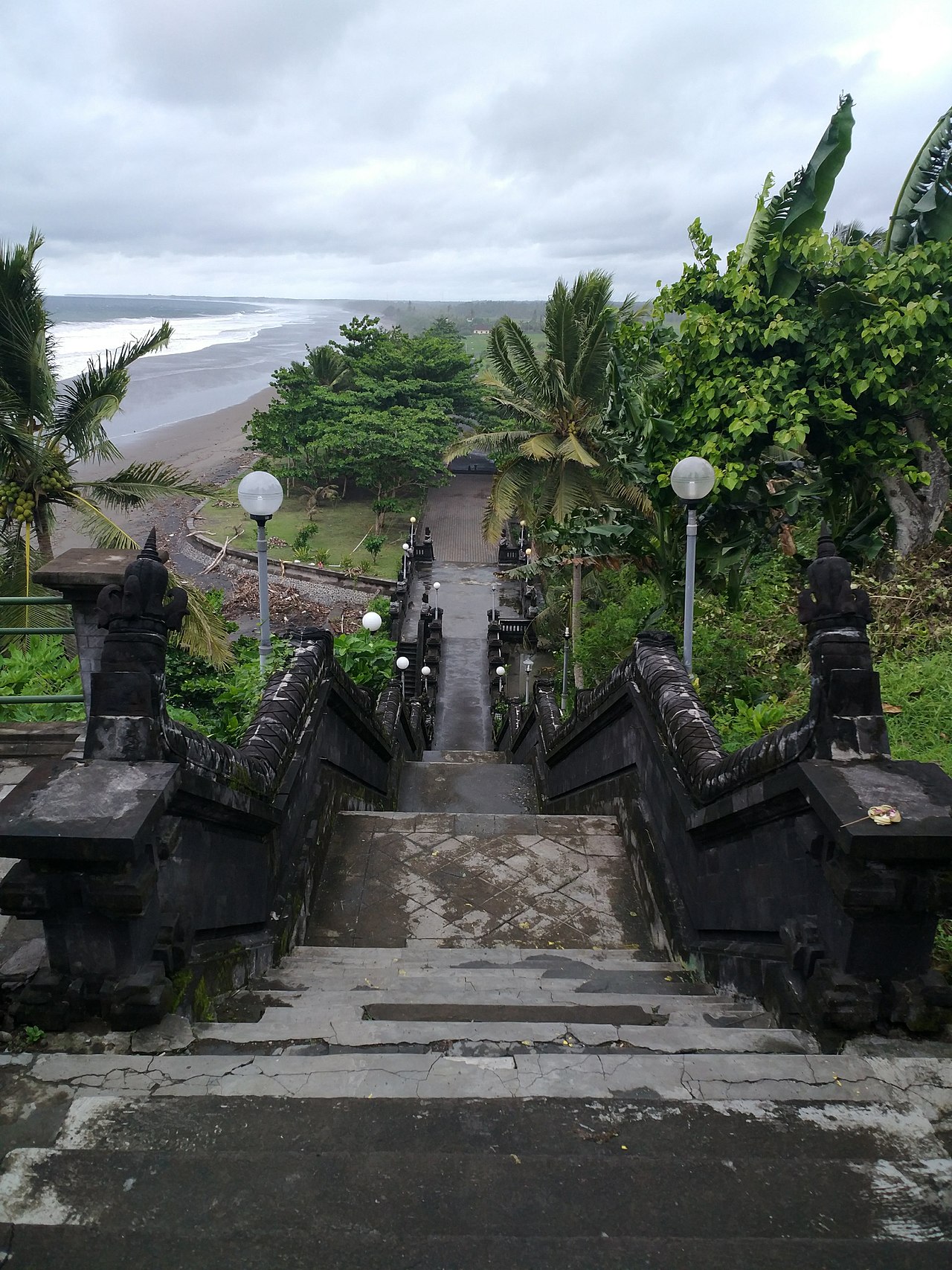
Pura Rambut Siwi — Winding 30-step cliffside stone stairway connecting the upper forested shrine to the dramatic black sand beach below.

Pura Rambut Siwi — Expansive black volcanic sand shoreline and ocean surf directly accessible at the base of the sacred temple cliff.
Cultural, Historical & Architectural Guide
Comprehensive Cultural Guide: Pura Rambut Siwi
1. Comprehensive Overview & Cultural Significance
Perched majestically upon towering ocean bluffs along the dramatic southwest coast of Bali in Jembrana regency, Pura Rambut Siwi is one of the island's most spiritually commanding and visually breathtaking Dang Kahyangan sea temples. While southern maritime sanctuaries like Uluwatu and Tanah Lot have become heavily commercialized hubs on standard tourist bus routes, Pura Rambut Siwi preserves the raw, untamed majesty of Bali’s wild western frontier. Here, the thundering roar of Indian Ocean surf meets the quiet rustle of wind-bent palms, framing an ancient pilgrimage sanctuary steeped in maritime lore, priestly miracles, and five centuries of unbroken devotion.
The cultural and religious primacy of Pura Rambut Siwi is deeply rooted in its status as a Dang Kahyangan—a supreme coastal sanctuary established to maintain the spiritual equilibrium (jagadhita) of the entire island. In Balinese theological geography, coastal sea temples are strategically positioned along the maritime perimeter to pacify the unpredictable, chaotic forces of the ocean realm (kelod / segara), transforming turbulent marine energy into protective divine blessings. Founded in the 16th century by the supreme Javanese-Balinese priest Dang Hyang Nirartha, Pura Rambut Siwi is venerated as the guardian of travelers, fishermen, and pilgrims traversing the vital overland and maritime corridors connecting Bali to neighboring Java.
Visitors to Pura Rambut Siwi are immediately captivated by its dramatic panoramic setting. The temple complex stretches from the coastal highway down across sweeping clifftops to glistening black volcanic sand beaches below. Across the shimmering expanse of the Bali Strait, the misty silhouettes of East Java’s volcanic mountain ranges dominate the western horizon, providing an unforgettable backdrop for afternoon sunsets that paint the sea in brilliant shades of gold, amber, and deep crimson. For travelers seeking an authentic encounter with Balinese coastal spirituality, far from the crowds of the south, Pura Rambut Siwi is an indispensable journey into the island's mythic past.
The sanctuary embodies the profound Balinese worldview of Tri Hita Karana—the harmonious balance uniting human society (pawongan), the natural environment (palemahan), and the transcendent realm (parahyangan). As the spiritual anchor of Jembrana, the temple serves not only regional devotees, but also thousands of travelers who cross the island daily. The sight of long-distance truck drivers, family motorists, and pilgrims pausing side by side at the roadside shrine to receive holy water sprinkles (tirta) before continuing their journey is a moving testament to the living vitality of Balinese religious tradition.
2. Exact Geographic Positioning & Micro-Terrain
Pura Rambut Siwi is located in Banjar Yeh Embang Kangin, within the administrative boundaries of Mendoyo District, Jembrana Regency. Perched at an elevation of approximately 25 meters above sea level on sheer coastal bluffs, the temple commands sweeping, unobstructed vistas over the open expanse of the Indian Ocean. It is situated directly along the national coastal highway connecting Denpasar to the western ferry port of Gilimanuk, roughly 85 kilometers west of Denpasar and approximately 20 kilometers east of the regency capital of Negara.
The topography of Pura Rambut Siwi presents a dramatic coastal cliff formation. The upper temple mandalas occupy a broad, level headland plateau carpeted with manicured lawns and shaded by mature sea hibiscus, coastal pandanus, and frangipani trees. From the clifftop, paved stone pathways and a flight of approximately 30 wide stone steps descend the cliff face, connecting the upper sanctum to the sacred freshwater spring (Pura Tirta) and the wide black volcanic sand beach below.
The physical difficulty rating for exploring Pura Rambut Siwi is classified as EASY. Navigating the upper temple grounds and primary courtyards involves level stone walkways and minimal physical effort, making the main sanctum fully accessible to travelers of all physical capabilities. For visitors wishing to descend to the beachside cave shrines and freshwater spring, the 30 stone steps are well-constructed and equipped with sturdy railings. Mindful footing is advised along the lower cliff paths where sea spray and ocean mist can make the stone surfaces damp.
Ecologically, the temple micro-climate is shaped by strong, refreshing oceanic breezes and intense equatorial sunshine. The relentless ocean winds keep the clifftops pleasantly cool throughout the day, though travelers should secure wide-brimmed hats and personal belongings when standing near the cliff edges. During spring high tides, dramatic ocean swells crash against the base of the cliffs, sending white plumes of spray high into the air.
3. Mythological Genesis & Sacred Lore
The sacred mythology of Pura Rambut Siwi is inextricably linked to the legendary life of Dang Hyang Nirartha, the venerated 16th-century high priest who revolutionized Balinese religion, temple architecture, and literature. According to sacred chronicles (babad), Dang Hyang Nirartha made an epic spiritual pilgrimage across the length and breadth of Bali, consecrating major coastal temples including Uluwatu, Tanah Lot, and Rambut Siwi.
When Nirartha arrived in western Bali, he found the coastal settlement of Yeh Embang plagued by strange diseases and severe agricultural failure. Local shamans had been powerless to halt the dying crops and sickness. Recognizing that negative psychic energies from the ocean were disturbing the community's equilibrium, Nirartha climbed the sea cliff and entered deep meditative absorption (samadhi). Through his intense spiritual austerities, he pacified the demonic sea entities (buta kala) and commanded the subterranean waters to burst forth as a clean, healing spring from the cliff rock. Within days, the sick villagers recovered, and the parched fields were miraculously rejuvenated.
When the grateful villagers begged Nirartha to dwell among them permanently, the holy sage explained that his divine mission required him to travel eastward to the royal court of Gelgel. However, seeing their genuine devotion, he offered a lock of his own hair (rambut) as a perpetual energetic link between his soul and their village. He instructed them: "Enshrine this hair with pure reverence (siwi). Whenever you face adversity, pray before this altar, and my spiritual protection shall descend upon your realm." To this day, the Balinese believe that the lock of hair remains spiritually active within the high Padmasana shrine, radiating divine protective vibrations that shield travelers on the coastal road and fishermen braving the dangerous ocean currents.
Another enduring local legend tells of a tiger that once terrorized the surrounding jungle. When the beast encountered Dang Hyang Nirartha in meditation beneath a tree, it was so overcome by the priest's radiant aura of non-violence (ahimsa) and spiritual majesty that it bowed down in total submission, becoming his faithful guardian. A dedicated stone tiger shrine (Pelinggih Macan) inside the courtyard commemorates this mythical event, where travelers pray for courage, physical vitality, and protection from wild predators and unseen dangers.
4. Chronicle of Priests, Sages & Dynasties
The historical chronicle of Pura Rambut Siwi reflects the golden era of classical Balinese kingdom history. During the mid-16th century, the island was unified under the enlightened rule of King Dalem Waturenggong of the Gelgel dynasty. King Waturenggong appointed Dang Hyang Nirartha as the supreme royal high priest (Purohita), granting him imperial authority to reform religious rituals, introduce the multi-tiered meru shrine design, and establish the Padmasana lotus throne as the supreme architectural symbol of the formless Godhead, Sang Hyang Widhi Wasa.
Under royal Gelgel decrees, Pura Rambut Siwi was designated as an official Pura Dang Kahyangan, entitling it to perpetual royal patronage and the protection of regional princes. Successive regents of Jembrana contributed to the expansion of the temple, commissioning skilled stonemasons to build imposing red-brick gateways and fortified sea walls to protect the clifftop compound from coastal erosion. When Dutch colonial forces annexed western Bali in the late 19th century, colonial administrators recognized the profound veneration accorded to Rambut Siwi by local populations, ensuring that temple lands remained inviolate.
Today, custodial stewardship of Pura Rambut Siwi is maintained with immense pride by the customary village council of Desa Adat Yeh Embang Kangin, in close coordination with the Jembrana Regency Cultural Department and the Parisada Hindu Dharma Indonesia (PHDI). Hereditary village priests (pemangku) conduct daily ritual offerings and oversee the elaborate ceremonies that take place throughout the year. The community takes active measures to protect the fragile coastal cliffs, planting deep-rooted coastal vegetation and reinforcing stone retaining walls using traditional construction techniques to preserve the monument for future generations.
5. Architectural Anatomy & Sacred Relics
The architectural layout of Pura Rambut Siwi represents an exceptional synthesis of classical Balinese spatial cosmology and responsive coastal engineering:
- Pura Pesanggrahan (Highway Gate Temple): Located directly beside the national highway, this roadside temple features a wide stone forecourt, a shaded bale pavilion for visiting travelers, and a dedicated blessing altar where passing motorists stop to receive holy water and floral blessings (bija) for road safety.
- Candi Bentar (Monumental Coastal Split Gate): Marking the entrance to the upper clifftop compound, this grand split gateway is constructed from dark andesite stone and rich red terracotta brick. Its soaring vertical wings frame an awe-inspiring vista of open ocean and crashing surf, symbolizing the conscious crossing from secular travel into sacred maritime ground.
- The Padmasana of the Sacred Hair: The focal spiritual relic of the entire complex, situated at the most elevated point of the inner courtyard (Utama Mandala). This magnificent stone lotus throne is intricately carved with reliefs of the cosmic turtle Bedawang Nala, entwined by two giant crowned serpents (Naga Anantaboga and Naga Basuki), representing the foundational forces supporting the earth. It is here that the sacred hair relic of Dang Hyang Nirartha is spiritually venerated.
- Multi-Tiered Meru Towers: Soaring timber meru towers with tiered roofs thatched in black sugar-palm fibers (ijuk) stand proudly against the coastal horizon. These shrines are dedicated to the supreme deities of Mount Agung, Mount Batukaru, and Lord Varuna, the ruler of the oceans.
- Pura Tirta Spring Grotto: Carved into the middle tier of the sea cliff, this sheltered grotto encloses a natural freshwater spring that emerges miraculously from basalt rock mere meters from the pounding ocean surf. The spring is enclosed by mossy stone walls and features a dedicated priest’s blessing station.
- Pura Goa Maya & Pura Segara: Located on the black volcanic sand beach below the bluff, these lower shrines feature natural sea caves where ancient hermits practiced meditation, alongside ocean-facing altars where coastal purification rites (Melasti and Nganyut) are conducted.
6. Essential Etiquette, Awig-Awig & Taboos
As one of Bali’s premier holy sea sanctuaries, Pura Rambut Siwi enforces strict customary bylaws (awig-awig) to safeguard its religious sanctity:
- Sacred Dress Code: Modesty is strictly enforced across all courtyards. All visitors must wear a traditional Balinese sarong (kamen) covering the legs below the knee, secured firmly with a waist sash (selendang). Shoulders and upper torsos must be covered with a sleeved shirt or blouse. Revealing beachwear, swimsuits, and sleeveless tank tops are strictly prohibited. Sarongs and sashes are available for loan at the entrance desk.
- Cliff Safety Regulations: Visitors must remain within designated stone pathways, viewing terraces, and fenced overlooks. Wandering beyond safety barriers onto loose cliff edges or slippery seaward rocks is dangerous and strictly prohibited due to sudden ocean wind gusts and crumbly shale deposits.
- Menstruation and Blood Taboo (Cuntaka): In accordance with universal Balinese Hindu purity regulations, individuals who are actively menstruating, persons with open bleeding wounds, or anyone currently observing a mourning period for a recently deceased family member must refrain from entering the inner sanctum courtyards and the cliffside spring.
- Respect for Devotees and Rituals: Devotees at Rambut Siwi are frequently engaged in solemn prayers for family protection and maritime safety. Maintain respectful silence, speak in low tones, and never position yourself directly between a praying worshiper and the altar. Do not use flash photography during sacred prayers.
- Aerial Drone Ban: Drones are strictly forbidden from flying over active temple courtyards, meru towers, or clifftop prayer areas without advance written authorization from the Desa Adat Yeh Embang Kangin.
7. Practical Logistics & Optimal Timing
Pura Rambut Siwi is an essential cultural stop for anyone exploring western Bali or traveling overland between Bali and Java:
- Optimal Time of Day: The premier time to visit is late afternoon between 16:00 and 18:30. Arriving in the late afternoon allows you to explore the courtyards in pleasant, cooled conditions and witness the extraordinary spectacle of the sunset over the Indian Ocean. Morning hours (08:00 to 10:30) also offer crystal-clear views across the sea toward East Java before afternoon thermal haze develops.
- Duration of Visit: Allocate approximately 60 to 75 minutes for a thorough exploration, which provides ample time to tour the upper temple mandalas, admire the coastal architecture, descend the cliff stairs to the freshwater spring grotto, and watch the sunset from the cliffside terrace.
- Transportation & Highway Routing: Pura Rambut Siwi is situated along the main Denpasar-Gilimanuk coastal highway. Because online ride-hailing services (Grab and Gojek) do not operate in rural Jembrana, visitors should travel via private car with a dedicated driver or by touring motorcycle. The temple serves as the ideal halfway rest stop on a day-long western coastal journey.
- Road Conditions & Safety: The national highway is fully paved and generally well-maintained, though it carries heavy commercial freight traffic, including inter-island buses and trucks. Drive defensively, particularly during night hours or sudden monsoon rainstorms.
- Parking & Facilities: An expansive asphalt parking concourse accommodates tour vans, private cars (IDR 5,000), and motorcycles (IDR 2,000). The arrival plaza features clean public restrooms, shaded resting bales, ticket kiosks, and local warungs offering cold refreshments and fresh coconuts.
8. Entry Tariffs & Transparent Inclusions
Admission fees at Pura Rambut Siwi are regulated transparently by the Jembrana Regency Tourism Office in partnership with Desa Adat Yeh Embang Kangin:
- Foreign Adult Ticket: IDR 40,000 (approx. USD $2.58)
- Foreign Child Ticket (Ages 5-11): IDR 20,000 (approx. USD $1.29)
- Domestic Indonesian Adult: IDR 20,000
- Domestic Indonesian Child: IDR 10,000
Transparent Inclusions: Every admission ticket includes full access to the upper temple courtyards, the clifftop viewing terraces, the 30-step cliff descent, the freshwater spring shrine, and the beachside cave grottos, as well as the complimentary loan of a traditional sarong and sash. Revenue generated from tariffs directly funds the structural maintenance of the cliffside masonry, coastal anti-erosion seawalls, daily waste management, and the community's traditional ceremonial calendar.
9. Sustainable Tourism & Respectful Visits
Because Pura Rambut Siwi is perched upon a dynamic and fragile coastal bluff ecosystem, mindful travel practices are essential:
- Ocean Waste Stewardship: Plastic waste carried by sea breezes can easily blow into the ocean, threatening marine turtles and coastal reef systems. Ensure all plastic water bottles, snack wrappers, and personal rubbish are securely deposited in trash receptacles near the parking concourse. Never discard rubbish over the cliff edge.
- Support Jembrana’s Rural Economy: Western Bali receives only a tiny fraction of the island’s tourism revenue. Stopping at the family-run warungs outside the temple gates to enjoy fresh young coconuts, local bananas, or traditional Jembrana coffee provides direct, equitable economic support to local village households.
- Respectful Coastal Exploration: When walking on the black volcanic sand beach below the cliffs, be mindful of sacred offering trays (canang sari) placed at the tide line. Avoid disturbing sea caves that serve as meditation retreats for local priests. By traveling with reverence and mindfulness, visitors honor the enduring spiritual legacy of Dang Hyang Nirartha on Bali's wild western coast.
Mythological Origins, Foundation Chronicles & Sacred Sages of Pura Rambut Siwi
Dramatically positioned atop high coastal bluffs overlooking the crashing surf of the Indian Ocean in western Bali, Pura Rambut Siwi is revered as the premier Dang Kahyangan sea sanctuary of Jembrana regency. The sacred origins of this iconic maritime temple are inextricably woven into the legendary spiritual pilgrimage (dharmayatra) of the great 16th-century Javanese-Balinese high priest Dang Hyang Nirartha, reverently remembered across Bali as Pedanda Sakti Bau Rauh.
According to the classical palm-leaf epic chronicle Dwijendra Tattwa, Dang Hyang Nirartha arrived in western Bali after crossing the treacherous Bali Strait from Blambangan, East Java, during the golden age of the Gelgel Kingdom under King Dalem Waturenggong. As the revered sage traveled through the dense coastal forests of Jembrana, he discovered a coastal village gripped by a devastating plague and crop failure. Filled with boundless compassion (karuna), Dang Hyang Nirartha offered powerful spiritual prayers, channeled divine healing energy, and miraculously cured the suffering villagers, while banishing the malevolent sea spirits causing the pestilence. Overwhelmed by gratitude and awe, the local village chieftain and elders begged the holy sage for a permanent sacred talisman (piagem) to protect their land and descendants from future calamities.
In response, Dang Hyang Nirartha reached up, pulled a lock of his own sacred hair (rambut), and bestowed it upon the village elders. He commanded them to erect a holy shrine atop the ocean cliff and to perpetually venerate and worship (siwi or disiwi) this sacred hair relic. He prophesied that as long as the people honored this holy bond, western Bali would be shielded from epidemics, maritime disasters, and hostile foreign invasions, while all travelers journeying along the coastal path between Java and Bali would receive divine safe passage. Thus, the sanctuary became forever known as Pura Rambut Siwi—the Temple of the Veneration of the Sacred Hair.
Architectural Anatomy, Spatial Cosmology & Sacred Relics of Pura Rambut Siwi
Pura Rambut Siwi represents a breathtaking masterpiece of coastal Balinese sacred architecture, integrating dramatic maritime geology with classical multi-level spatial design. Unlike inland temples enclosed within a single rectangular compound, Rambut Siwi is a vast sacred complex comprising several interrelated shrines distributed across the coastal bluffs, cliff faces, and black-sand beaches:
- Pura Pesanggrahan (Roadside Arrival Temple): Situated adjacent to the main coastal highway, this outer precinct serves as an essential stopping place where travelers and motorists pause to present offerings, receive holy water sprinkles (tirta), and pray for safe journeys before continuing along the western highway.
- Pura Luhur Rambut Siwi (The Upper Cliff Sanctum): The majestic crown of the complex, perched 25 meters above the churning sea on the crest of the coastal bluffs. Entered through an imposing Candi Bentar (split gate) crafted from warm red terracotta brick and volcanic andesite stone, the upper sanctuary features a classical Tri Mandala layout. The inner courtyard houses multi-tiered meru towers with black sugar-palm thatch (ijuk), open assembly pavilions (bale pesamuan), and the sacred Padmasana—an intricately carved stone lotus throne elevated on a high stepped plinth, where the holy hair relic of Dang Hyang Nirartha is spiritually enshrined.
- Pura Tirta (The Sacred Freshwater Cliff Spring): Situated halfway down the cliff face, this hidden grotto shrine marks the miraculous site where a spring of pure, sweet freshwater emerges directly from the coastal rock just meters above the crashing salt waves. Devotees collect this water for purification rites.
- Pura Segara & Pura Goa Maya (The Ocean and Cave Shrines): Located at the base of the bluffs directly on the black volcanic sand beach, these coastal shrines honor Lord Varuna (the sea deity) and provide subterranean meditation grottos where ascetics historically practiced sensory withdrawal (samadhi).
The architectural ensemble is unified by durable indigenous materials: dark volcanic basalt that withstands salty sea winds, warm red clay bricks, ironwood pillars, and black sugar-palm thatch. Stone parapets along the cliff edge feature guardian sculptures (dwarapala) gazing perpetually out toward the vast expanse of the Indian Ocean.
Frequently Asked Questions & Local Logistics
Key logistical insights, official tariffs, and customary etiquette for Pura Rambut Siwi.
Top Curated Stays Near Pura Rambut Siwi
Curated accommodations within 8km radius, ranked by traveler ratings and shortest transit times.

Arton Resort & Beach Club

West Break Bali Medewi

Wide Sands Beach Retreat

MADEWITH hostel
Curated Experiences Near Pura Rambut Siwi
Curated guided tours and local adventures operated within easy transit of this landmark.

Pererenan Black Sand Beachfront Dawn Horseback Riding
Gallop through the tide lines of glittering black volcanic sand at early sunrise.

Sunrise Beach Horseback Trek along Pererenan Coast
Curated Balinese experience: Sunrise Beach Horseback Trek along Pererenan Coast. Part of Bali Expert Guide's signature curated journeys.

Medewi Point Guided Surf Coaching & Wave Guiding
Curated Balinese experience: Medewi Point Guided Surf Coaching & Wave Guiding. Part of Bali Expert Guide's signature curated journeys.