


Bayung Gede Ancient Highland Village
Salah satu desa adat Bali Aga tertua di dataran tinggi Kintamani yang melestarikan adat Austronesia pra-Hindu, Bale Agung komunal, serta Hutan Sakral Setra Ari-Ari yang melegenda.
📜 Latar Belakang Sejarah & Makna Budaya
Didirikan oleh komunitas asli Bali Aga jauh sebelum era Majapahit, Bayung Gede merupakan desa induk leluhur dari warga Penglipuran dengan sistem kekerabatan patrilineal dan musyawarah tetua adat.
Tarif Resmi Tiket Masuk
| Kategori Pengunjung | Tarif Resmi (IDR) | Est. (USD) | Inklusi & Catatan |
|---|---|---|---|
| Domestic / WNI (Adult) | IDR 20.000 | $1.12 | Domestic visitor admission & guide |
| Domestic / WNI (Child) | IDR 10.000 | $0.56 | Domestic child ticket |
| Foreign Tourist (Adult) | IDR 50.000 | $2.81 | Village admission & certified local cultural guide to Setra Ari-Ari |
| Foreign Tourist (Child) | IDR 30.000 | $1.69 | Foreign child ticket (Ages 5–11) |
Etika Budaya Bali & Hukum Adat Awig-Awig
Pedoman resmi adat desa dan tata tertib tempat suci untuk Bayung Gede Ancient Highland Village.
Wajib mengenakan kamen (sarung) dan selendang khas Bali. Bahu dan lutut tertutup sopan. Wajib melepas alas kaki sebelum menginjakkan kaki di Bale Agung. ✓ Wajib mengenakan kain sarung dan selendang kuning untuk masuk.
Awig-Awig Desa Adat Bayung Gede: Dilarang membawa miras, bersuara gaduh, atau memotret sesepuh tanpa izin. Wanita haid dilarang memasuki area Bale Agung dan Hutan Setra Ari-Ari. ⚠️ Berdasarkan teologi Hindu Bali, wanita yang sedang haid dan orang yang sedang terluka berdarah dilarang memasuki area suci pura.
Zona Terlarang Terbang Ketat. Penerbangan drone dilarang keras di seluruh kawasan Bale Agung, pura desa, dan Hutan Setra Ari-Ari demi menjaga kesucian niskala desa adat.
Sepeda Motor: IDR 2.000
Mobil Penumpang: IDR 5.000
Sorotan Visual & Arsitektur (7 Foto)
Transportation & Access Radar
No Grab/Gojek service. Private driver essential.
Mountain roads can be slippery in wet season; always engage a licensed cultural guide to mediate respectful village entry. Photography of elders requires explicit permission.
Radar Elevasi & Aksesibilitas
Navigasi & Transit
Panduan Budaya, Sejarah & Arsitektur
Comprehensive Cultural Guide: Bayung Gede Ancient Highland Village
1. Comprehensive Overview & Cultural Significance
Desa Adat Bayung Gede stands as an extraordinary living monument to the pre-Hindu Austronesian origins of Balinese civilization. Situated at a crisp elevation of 1,050 metres above sea level along the southern volcanic rim of the Mount Batur caldera in Bangli Regency, this ancient highland settlement is officially recognized as one of the oldest and most culturally intact Bali Aga (indigenous Balinese) communities on the island. Long before the 14th-century Javanese-Majapahit expedition altered the religious, linguistic, and political landscape of lowland Bali, the people of Bayung Gede had established an egalitarian, nature-revering societal structure that has endured with astonishing resilience into the twenty-first century.
Unlike typical tourist villages that have adapted their rhythms to commercial expectations, Bayung Gede remains an authentic, working agricultural and ceremonial sanctuary. Its villagers cultivate heritage highland crops—including oranges, Arabica coffee, sweet potatoes, and highland corn—while maintaining unbroken fidelity to customary customary bylaws (awig-awig) that govern everything from marriage protocols and architectural proportions to forestry conservation. Bayung Gede is historically celebrated as the ancestral "mother village" of Penglipuran; centuries ago, migrants from Bayung Gede established Penglipuran, replicating its iconic linear village layout, bamboo architecture, and communal discipline.
For cultural anthropologists, historians, and respectful travelers, Bayung Gede offers an unparalleled opportunity to witness Bali's ancestral soul in its purest, unvarnished form. From its monumental Bale Agung longhouse to its world-famous Setra Ari-Ari (Sacred Placenta Forest), the village provides a profound testament to a civilization that views humanity not as the conqueror of nature, but as an humble, integrated custodian of the sacred natural order.
2. Exact Geographic Positioning & Micro-Terrain
Bayung Gede is located at coordinates -8.2789° S latitude, 115.3456° E longitude, positioned within the administrative district of Kecamatan Kintamani, Bangli Regency. Nestled on the high volcanic plateau south of Lake Batur, the village rests at an average elevation of 1,050 metres above sea level. This high altitude blesses the settlement with a cool, invigorating highland micro-climate: daytime temperatures hover between 18°C and 24°C, while night and early morning temperatures frequently drop to a brisk 14°C, with heavy mountain mists descending over the settlement by mid-afternoon.
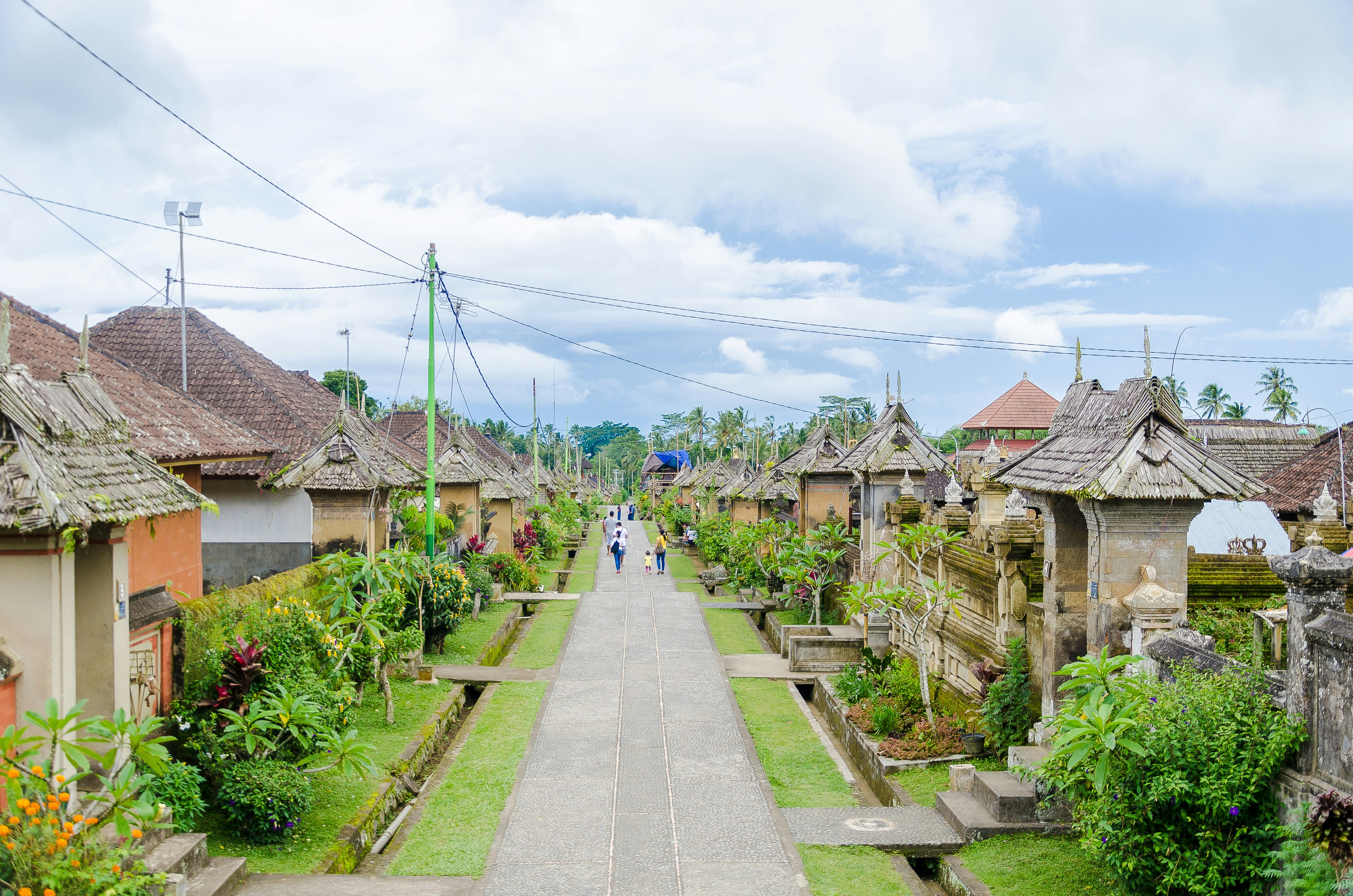
The physical terrain of the village is structured along a gentle north-to-south gradient. The central village artery is a paved, vehicle-free walking concourse lined with low volcanic-earth boundary walls and traditional gateways. Access to peripheral areas, including the surrounding organic farms and the Sacred Placenta Forest, involves traversing packed earth pathways and gentle stone-lined inclines shaded by mature bamboo groves and tropical hardwood trees.
The physical difficulty rating for exploring Bayung Gede is classified as EASY. The village paths are level and easily navigable on foot. However, because morning dew and afternoon mountain rains can make stone paving and earthen paths slippery, visitors are strongly advised to wear sturdy walking shoes with reliable traction. The village is peaceful and quiet, with motorized vehicles strictly prohibited inside the residential core.
3. Mythological Genesis & the Mountain Spirits of Batur
The metaphysical foundations of Bayung Gede are rooted in ancient Austronesian animism harmonized with early Shaivite-Buddhist cosmological concepts. In the oral traditions of the village priests (pemangku), the founders were guided to this highland plateau by divine omens sent by the protective spirits of Mount Batur. The village's sacred geographical position between Mount Batur to the north and the southern plains establishes an energetic balance protecting the island from volcanic catastrophe and pestilence.
Central to the spiritual life of Bayung Gede is the concept of ancestral purity (kesucian leluhur). The villagers believe that ancestral spirits do not depart to a distant celestial heaven, but remain actively present within the settlement, dwelling in the upper rafters of the Bale Agung and among the sacred trees of the surrounding forests. Annual ceremonial cycles, calculated using the ancient 210-day Pawukon calendar, feature elaborate communal feasts where offerings of mountain honey, raw grains, and sacred spring water are presented to ensure agricultural fertility and communal peace.
A defining spiritual taboo (pantangan) in Bayung Gede concerns the absolute inviolability of the earth. Because the village ground is consecrated as pure ancestral territory, dead human bodies are never buried directly within the residential precinct. Even more remarkably, the biological afterbirth (ari-ari) of newborn infants is strictly forbidden from touching the soil—a foundational spiritual edict that gave rise to the village's world-famous arboreal placenta traditions.
4. Chronicle of the Mother Village & the Migration to Penglipuran
The historical trajectory of Bayung Gede occupies a seminal chapter in the royal history of Bangli. During the classical era of Balinese kingdoms, the highland settlements of Kintamani functioned as semi-autonomous mountain republics whose warrior-farmers owed allegiance directly to the sacred mountain deities rather than lowland feudal princes. Royal edicts preserved on ancient copper plates (prasasti) document that the kings of Bangli maintained deep respect for the spiritual autonomy of Bayung Gede, frequently sending royal emissaries to seek blessings from its high priests during times of drought or epidemic.
In the 18th century, a historic demographic event occurred. The Kingdom of Bangli required loyal, disciplined guardians to secure its southern borders and manage royal agricultural lands near Kubu. A significant contingent of families from Bayung Gede was selected to establish a new settlement. Carrying their ancestral traditions, architectural knowledge, and social bylaws with them, these pioneers founded Desa Penglipuran (derived from Pengeling Pura, meaning "monument of remembrance to the ancestral temple"). While Penglipuran later evolved into a celebrated, manicured tourist showcase, Bayung Gede remained in its pristine, rustic mountain sanctuary, quietly safeguarding the ancient rituals in their original, unembellished form.
In recent decades, Bayung Gede has received international scholarly recognition. Anthropologists and cultural geographers from universities worldwide have documented its unique social governance and ecological wisdom. The custodial community (Desa Adat) has established a measured, community-controlled approach to cultural tourism: welcoming scholarly visitors and mindful travelers while resolutely prohibiting commercial mass-tourism intrusions that could disrupt its sacred way of life.
5. Architectural Anatomy & the Sacred Placenta Forest
The architectural landscape of Bayung Gede is a triumph of vernacular ecological engineering. The spatial layout reflects the sacred tripartite division (Tri Hita Karana):
- Parahyangan (Sacred Realm): The northernmost, highest elevation contains Pura Ulun Suwi, constructed from dark volcanic basalt and thatched with dense layers of black sugar palm fibers (ijuk). The shrines feature archaic geometric motifs distinct from the ornate floral flourishes of lowland Majapahit temples.
- Pawongan (Human Realm): The central spine contains the Bale Agung, a magnificent communal longhouse measuring over forty metres in length. Its open-sided architecture allows natural mountain breezes to flow freely, while massive structural columns (saka) support a soaring thatched roof assembled entirely without iron nails.
- Palemahan (Natural Realm): The southern and peripheral zones encompass the agricultural lands, bamboo conservation reserves, and sacred groves.
The Sacred Placenta Forest (Setra Ari-Ari)
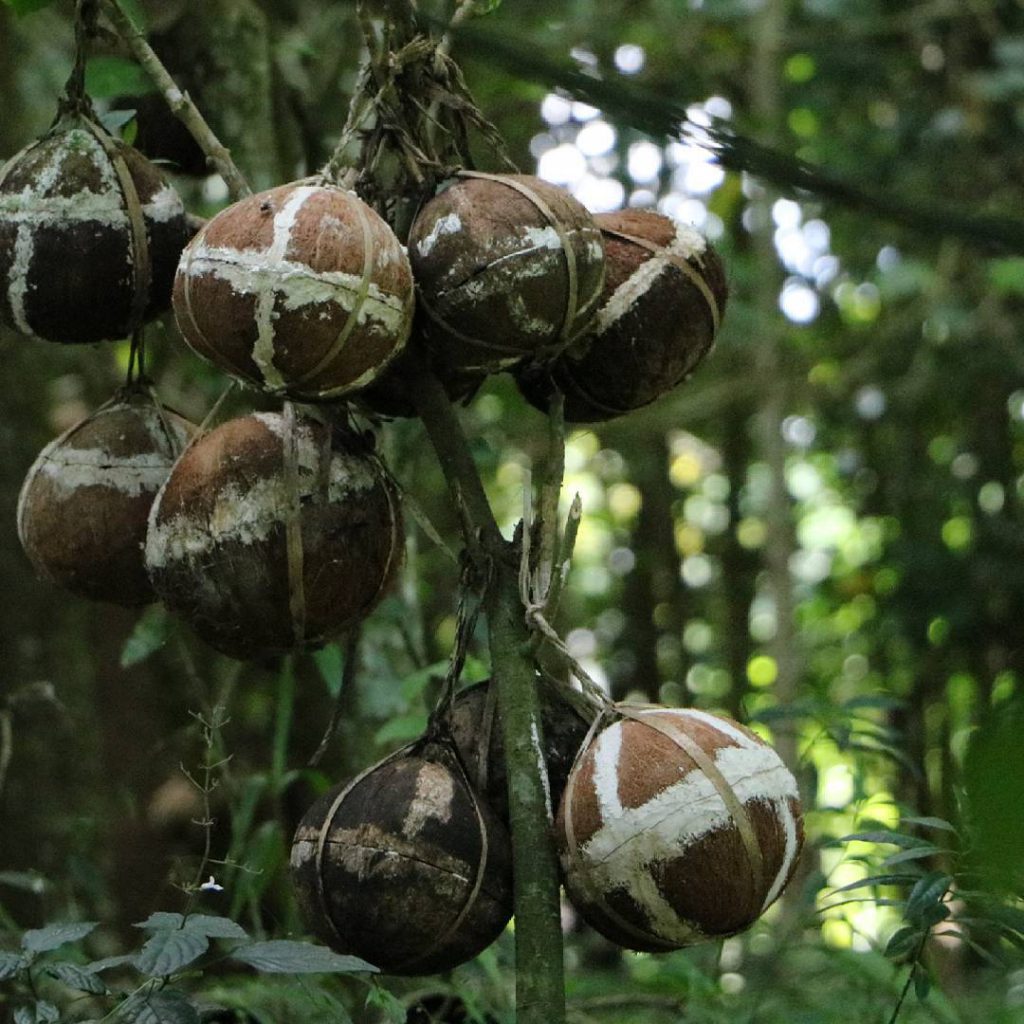
Located approximately five hundred metres south of the residential center lies the Setra Ari-Ari. When a child is born in Bayung Gede, the father meticulously cleans the placenta (ari-ari), mixes it with salt, turmeric, and fragrant camphor, and seals it inside a halved coconut shell (kendang). The shell is tied tightly with bamboo fibers and carried in solemn reverence to the sacred grove. There, the father climbs a mature bukak tree (Alstonia scholaris) and suspends the coconut shell from a sturdy branch. Over decades, hundreds of these coconut shells hang among the mossy branches, slowly decomposing and returning their nutrients to the forest canopy without producing any foul odor. Local belief holds that the fragrant resin of the native trees naturally neutralizes organic decomposition, creating a tranquil, deeply spiritual outdoor cathedral where the physical evidence of every living villager's birth remains permanently sheltered by the ancestral forest.
6. Essential Etiquette, Awig-Awig & Cultural Taboos
Because Bayung Gede is an active, deeply traditional sacred community, visitors must observe strict customary bylaws (awig-awig):
- Traditional Modest Attire: All visitors must wear a traditional Balinese sarong (kamen) fastened with a waist sash (selendang). Shoulders, upper arms, and knees must be completely covered. Footwear must be removed before stepping onto the raised wooden floors of the Bale Agung or any family pavilion.
- Strict Prohibition on Unsolicited Photography: Do not point cameras directly into private family courtyards, and never photograph village elders or children without asking polite permission first. Inside the Setra Ari-Ari, photography must be conducted with absolute quiet reverence—never touch, shake, or disturb the hanging coconut shells.
- Ritual Purity & Menstruation Taboo (Cuntaka): In accordance with millennia-old customary law, women who are actively menstruating, individuals with bleeding wounds, or anyone who has experienced a bereavement in their immediate family within recent days are strictly forbidden from entering the Bale Agung, the village temples, and the Setra Ari-Ari.
- Absolute Drone Prohibition: Operating unmanned aerial vehicles (drones) anywhere within the airspace of Desa Adat Bayung Gede is strictly prohibited to protect the spiritual sanctity of ancestral shrines and preserve village privacy.
- Quiet Demeanor: Maintain a low, respectful speaking volume throughout the village. Shouting, playing amplified music, and consuming alcoholic beverages are severe violations of village customary law.
7. Practical Logistics & Mountain Transport
Reaching Bayung Gede requires thoughtful preparation due to its remote highland geography:
- Optimal Time of Day: The most favorable window is early morning from 07:00 to 10:00. The morning air is crisp and clear, providing breathtaking vistas of Mount Batur and Mount Abang before midday cloud cover descends. Early morning also offers opportunities to witness village elders performing daily communal duties at the Bale Agung.
- Transportation Logistics: Bayung Gede is located approximately 55 kilometres northeast of Denpasar (allow 2 to 2.5 hours driving time) and 35 kilometres north of Ubud (allow 1 hour 15 minutes). The final two kilometres involve a winding, narrow mountain road that can be slippery during rainy periods; hiring an experienced private driver familiar with the Kintamani highlands is strongly recommended.
- Ride-Hailing Restrictions: There is no Grab or Gojek service in Bayung Gede. Do not attempt to rely on ride-hailing apps for return transportation from the village. You must arrange round-trip transportation with a private day driver who will wait for you during your visit.
- Highland Weather Preparedness: Temperatures at 1,050 metres altitude can be brisk, especially on overcast days. Bring a warm light jacket or fleece, a compact umbrella or rain poncho for sudden mountain showers, and sturdy walking shoes suitable for damp earthen paths.
8. Entry Tariffs & Transparent Inclusions
Desa Adat Bayung Gede administers an official community cultural heritage tariff, with all proceeds managed directly by the village cooperative:
- Foreign Adult Entry: IDR 50,000 (Includes village admission and official registered local guide accompaniment)
- Foreign Child Entry (Ages 5–11): IDR 30,000
- Domestic Indonesian Adult: IDR 20,000
- Domestic Indonesian Child: IDR 10,000
- Vehicle Parking Fees:
- Scooters and Motorcycles: IDR 2,000 per vehicle.
- Cars and Passenger Vans: IDR 5,000 per vehicle.
- Transparent Value Inclusions: The entry tariff directly funds the maintenance of ancient village temples, daily sanitation of communal spaces, preservation of the Sacred Placenta Forest, and fair compensation for village cultural guides who accompany visitors to explain oral histories and interpret sacred sites.
9. Sustainable Tourism & Cultural Preservation
As travelers seek deeper, more authentic cultural experiences across Bali, protecting Bayung Gede's delicate ecological and social fabric requires conscious, sensitive travel:
- Engage Official Village Cultural Guides: Always request a licensed local guide at the village entrance post. Village guides are native community members who possess intimate knowledge of customary protocols, oral lore, and botanical traditions. Engaging their services guarantees respectful navigation and directly injects economic support into local family households.
- Support Highland Organic Agriculture: Purchase locally produced agricultural goods directly from village families. Bayung Gede is renowned for sweet Kintamani oranges, Arabica coffee beans, wild mountain honey, and hand-woven bamboo baskets. Purchasing directly from residents eliminates middleman exploitation.
- Zero-Waste Responsibility: Plastic waste is a severe ecological hazard in fragile mountain ecosystems. Carry a reusable water bottle, refuse single-use plastic bags, and carry all personal refuse back to your hotel in Ubud or the lowlands. Never discard cigarette butts, plastic wrappers, or organic waste in the Sacred Placenta Forest.
- Cultural Humility: Approach Bayung Gede not as an open-air museum, but as a living sanctuary of real people practicing a sacred, unbroken way of life. By entering with humility, quiet curiosity, and deep respect, travelers contribute to the enduring survival of Bali's primordial heritage.
Ancestral Genesis, Austronesian Foundations & Sacred Rites of Bayung Gede
Perched at an elevation of 1,050 metres along the cool, mist-shrouded volcanic ridges of Kintamani in Bangli Regency, Desa Adat Bayung Gede stands as one of Bali's most venerable Bali Aga (indigenous Balinese) settlements. Founded centuries before the 14th-century Javanese-Majapahit expedition led by General Gajah Mada transformed lowland Balinese society, Bayung Gede preserves the primordial social architecture, cosmological cosmology, and ancestral customs of the island's earliest Austronesian settlers. According to indigenous palm-leaf chronicles (lontar) and the oral genealogies chanted by village elders during annual rites, the founders of Bayung Gede migrated upward along the sacred mountain slopes of Mount Batur (Gunung Batur), seeking a sanctified highland sanctuary where human life could exist in pristine communion with the mountain deities and celestial spirits.
The cosmological identity of Bayung Gede is intrinsically linked to the veneration of Bhatara Hyang Api (the Lord of Fire, manifested in the active volcanic presence of Mount Batur) and Dewi Danu (the goddess of Lake Batur, source of the island's agricultural lifeblood). Unlike the classical caste-stratified feudal hierarchy of lowland Balinese kingdoms, the social organization of Bayung Gede is fiercely egalitarian, governed by an ancestral elders' council (Krama Desa Adat) composed of married couples ranked strictly by the seniority of their initiation rather than royal birth. Every major civic and spiritual decision is reached through consensus within the monumental communal longhouse (Bale Agung), reflecting a democratic communal ethos that has survived uncorrupted for over a millennium.
Crucially, historical records identify Bayung Gede as the ancestral mother settlement (desa induk) of the famous traditional village of Penglipuran. In the 18th century CE, during the reign of the King of Bangli, a cohort of Bayung Gede's finest warriors and craftsmen was commissioned to establish an outpost approximately twenty kilometres to the south in Kubu to serve royal administrative and defensive duties; this splinter settlement retained the exact spatial layout, architectural bylaws, and bamboo forestry stewardship of Bayung Gede, eventually becoming modern Penglipuran. Consequently, visiting Bayung Gede is an extraordinary pilgrimage to the living root from which some of Bali's most celebrated cultural institutions originally germinated.
Austronesian Longhouse Architecture, Placenta Forest & Sacred Spatial Cosmology
The physical architecture and spatial orientation of Desa Adat Bayung Gede strictly adhere to the ancient Austronesian spatial axis of Kaja-Kelod (mountainward versus seaward). The village is laid out along a singular north-south linear spine that rises progressively toward the sacred volcanic heights of Mount Batur. The uppermost, most sacred sector (Utama Mandala) shelters the village sanctuary of Pura Ulun Suwi and the ancestral shrines. The middle sector (Madya Mandala) is occupied by the monumental Bale Agung—an extraordinary timber-and-thatch communal longhouse extending dozens of metres in length, constructed entirely without metal nails using interlocking mortise-and-tenon joints (purus) and secured with woven bamboo cordage. Here, the village council convenes on raised bamboo platforms, surrounded by massive wooden structural pillars carved from ancient mountain hardwood.
The domestic residential compounds (pekarangan) flanking the central village thoroughfare reflect an unvarnished, archaic aesthetic. Enclosed by low perimeter walls fashioned from dried volcanic earth and rough-hewn basalt stones, each family compound features a traditional hearth pavilion (paon), sleeping quarters (bale meten), and ancestral shrines thatched with thick, durable black sugar palm fibers (ijuk) or woven bamboo shingles (sirap bambu). The structural integrity of these highland dwellings is designed specifically to withstand the damp mountain mist, high humidity, and occasional seismic tremors characteristic of the Kintamani volcanic highlands.
Undoubtedly the most singular and internationally revered cultural-ecological relic preserved in Bayung Gede is the Setra Ari-Ari (The Sacred Placenta Forest). In traditional Balinese Hindu belief, the afterbirth (ari-ari) is regarded as one of the four spiritual siblings (Kanda Empat) that accompany a human soul into the world. While lowland Balinese families bury the placenta beside the family house doorway, the ancient awig-awig of Bayung Gede dictates that the placenta must never be buried in the earth, lest it defile the pristine sacred soil of the village. Instead, after a birth, the father cleanses the placenta with fragrant water, places it inside a dried, hollowed-out coconut shell (kendang), and hangs it high among the branches of native bukak trees in a dedicated ancestral forest grove on the village outskirts. The forest contains hundreds of hanging coconuts suspended in the mist, creating an otherworldly, reverent natural sanctuary where birth, nature, and ancestral spirit exist in perpetual, organic symbiosis.
Frequently Asked Questions & Local Logistics
Key logistical insights, official tariffs, and customary etiquette for Bayung Gede Ancient Highland Village.
Top Curated Stays Near Bayung Gede Ancient Highland Village
Akomodasi terkurasi dalam radius 8 km, diurutkan berdasarkan ulasan wisatawan dan waktu tempuh tercepat.

The Casa Lunamoon

Devanora Hotel & Resto

Black Lava Camp Kintamani

Mountain Peak Kintamani
Aktivitas Terkurasi Dekat Bayung Gede Ancient Highland Village
Curated guided tours and local adventures operated within easy transit of this landmark.

Mount Batur Sunrise Summit Trek with Hot Springs
Pre-dawn summit ascent across volcanic basalt ridges to watch the sunrise above Lake Batur and Mount Rinjani, followed by restorative thermal hot springs.

Ayung River Class II-III White Water Rafting
Thrilling 11-kilometer descent through the pristine rainforest gorges of Ubud, skimming past ancient Hindu rock carvings and hidden waterfall cascades.

Ubud Jungle ATV Quad Bike & Gorilla Cave Expedition
Off-road quad biking across rice fields, bamboo forests, muddy riverbeds, and through the dramatic hollow mouth of the Gorilla Cave.