


Trunyan Bali Aga Village & Sky Burial
Desa kuno Bali Aga di tepi timur Danau Batur yang tersohor dengan tradisi pemakaman terbuka (mepasah) di bawah naungan pohon purba Taru Menyan tanpa menimbulkan bau jenazah.
📜 Latar Belakang Sejarah & Makna Budaya
Permukiman prasejarah suku Bali Aga yang memuja arca megalitikum Da Tonta di Pura Pancering Jagat, mempertahankan kosmologi leluhur tanpa tradisi kremasi ngaben.
Tarif Resmi Tiket Masuk
| Kategori Pengunjung | Tarif Resmi (IDR) | Est. (USD) | Inklusi & Catatan |
|---|---|---|---|
| Domestic / WNI (Adult) | IDR 30.000 | $1.69 | Domestic visitor admission & village guide |
| Domestic / WNI (Child) | IDR 15.000 | $0.84 | Domestic child ticket |
| Foreign Tourist (Adult) | IDR 75.000 | $4.22 | Village admission & mandatory local custodial guide at Sema Wayah (chartered boat booked separately) |
| Foreign Tourist (Child) | IDR 40.000 | $2.25 | Foreign child ticket (Ages 5–11) |
Etika Budaya Bali & Hukum Adat Awig-Awig
Pedoman resmi adat desa dan tata tertib tempat suci untuk Trunyan Bali Aga Village & Sky Burial.
Wajib mengenakan kamen dan selendang sopan. Pakaian bernuansa tertutup dan santun. Wajib melepas alas kaki di area pelataran suci. ✓ Wajib mengenakan kain sarung dan selendang kuning untuk masuk.
Awig-Awig Desa Trunyan: Wajib menjaga keheningan mutlak di Sema Wayah. Dilarang keras menyentuh atau memindahkan tengkorak/tulang jenazah. Wajib didampingi pemandu resmi desa adat. ⚠️ Berdasarkan teologi Hindu Bali, wanita yang sedang haid dan orang yang sedang terluka berdarah dilarang memasuki area suci pura.
Zona Terlarang Terbang Ketat. Penerbangan drone dilarang keras di atas area Sema Wayah, pohon Taru Menyan, serta mandala suci Pura Pancering Jagat.
Sepeda Motor: IDR 2.000
Mobil Penumpang: IDR 5.000
Transportation & Access Radar
No Grab/Gojek. Arrange round-trip boat and private driver from Ubud or Kintamani.
Negotiate and agree on boat fare before departure; fix round-trip pricing in writing. Lake winds can be strong after noon — plan your return crossing by midday. A mandatory village guide must accompany all cemetery visits.
Radar Elevasi & Aksesibilitas
Navigasi & Transit
Sorotan Visual & Arsitektur (7 Foto)
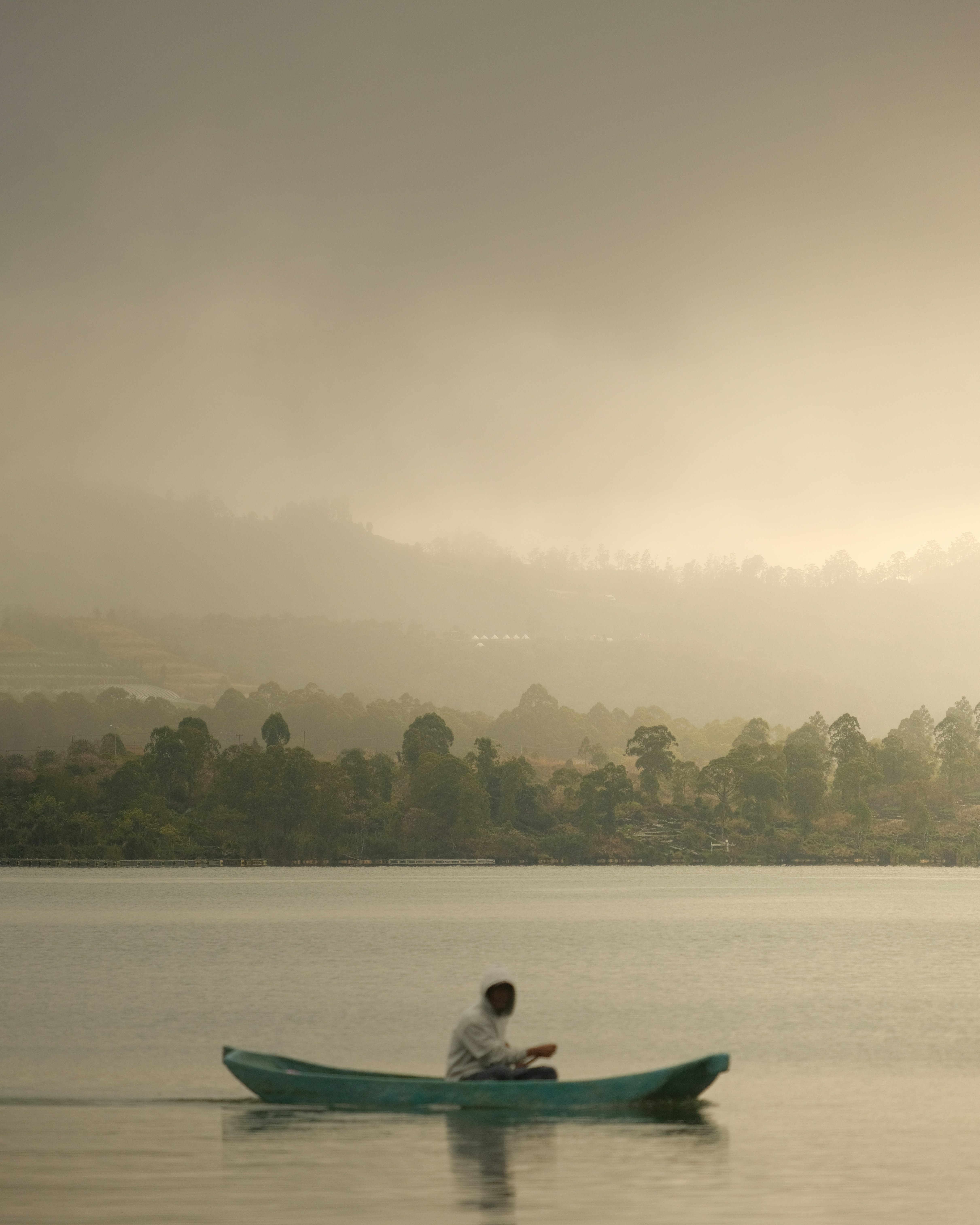
Trunyan Bali Aga Village — Traditional wooden jukung outrigger canoe navigating the calm morning waters of Lake Batur toward the isolated shoreline.
Photo: Arya Krisdyantara
Trunyan Bali Aga Village — The sacred open-air sky burial site (Sema Wayah) beneath the fragrant canopy of the ancient Taru Menyan tree.

Trunyan Bali Aga Village — Weathered ancestral human skulls respectfully arranged along the moss-covered stone cliff altar.
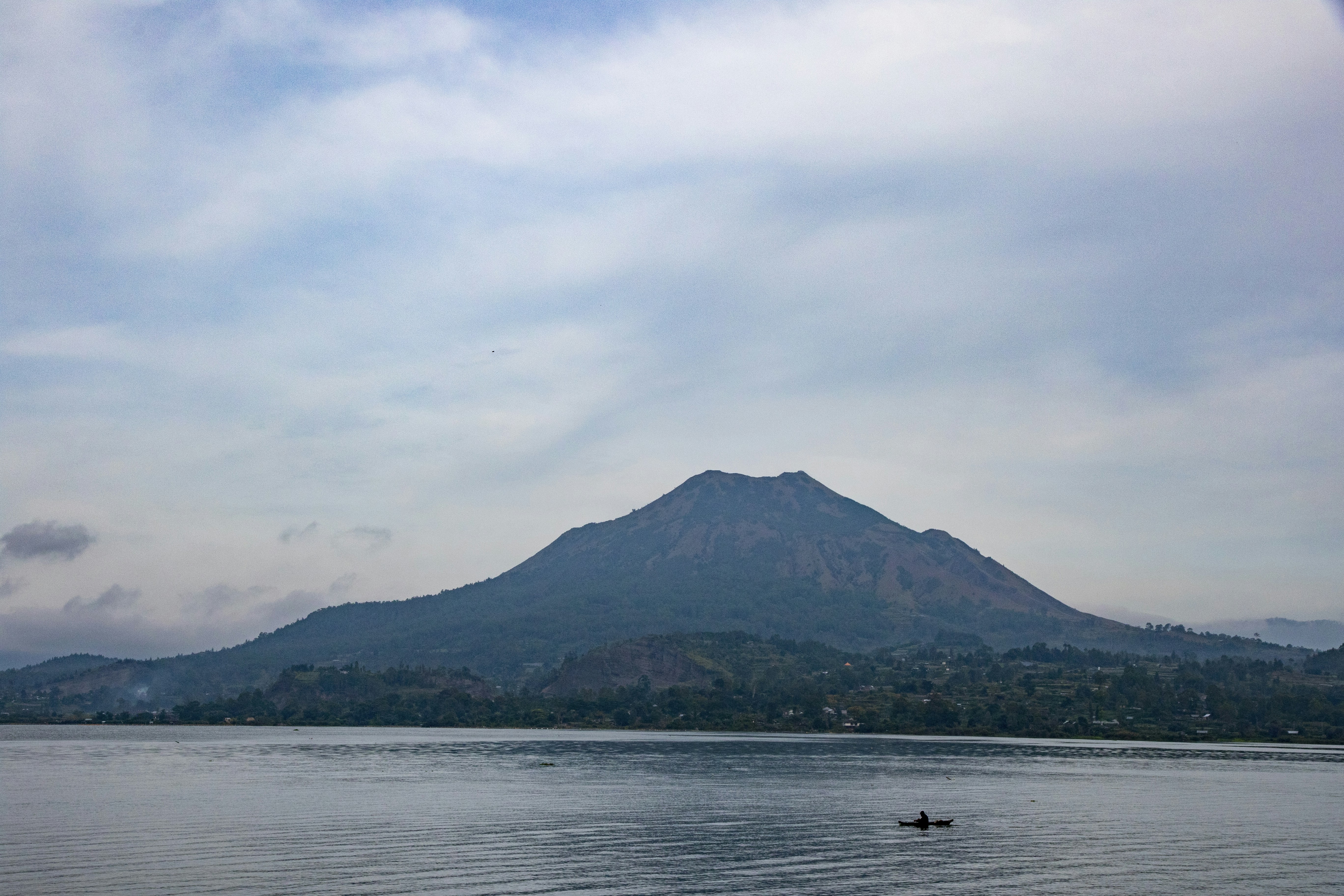
Trunyan Bali Aga Village — The dramatic caldera waters of Lake Batur sheltered beneath the soaring vertical ramparts of Mount Abang.

Trunyan Bali Aga Village — Rugged shoreline of eastern Lake Batur where ancient footpaths connect the village compounds to the lakeside jetties.
Panduan Budaya, Sejarah & Arsitektur
Comprehensive Cultural Guide: Trunyan Bali Aga Village & Sky Burial
1. Comprehensive Overview & Cultural Significance
Desa Trunyan stands as one of the most enigmatic, culturally unique, and anthropologically significant sanctuaries in the entire Indonesian archipelago. Tucked along the isolated eastern shore of volcanic Lake Batur (Danau Batur) in Bangli Regency, Trunyan is inhabited by the Bali Aga—the original indigenous people of Bali whose civilization predates the 14th-century Javanese-Majapahit migrations. Shielded by the towering walls of the Mount Abang caldera and accessible almost exclusively across the waters of the lake, Trunyan has preserved ancient Austronesian customs, animistic cosmologies, and mortuary rites that have remained virtually untouched for over a thousand years.
The defining global renown of Trunyan centers upon its unique open-air sky burial tradition (mepasah). Unlike the elaborate, fiery cremations (ngaben) practiced by mainstream Balinese Hindus in the lowlands, the deceased of Trunyan are neither cremated nor interred in the soil. Instead, their bodies are laid gently upon the volcanic earth beneath the canopy of a thousand-year-old sacred tree known as the Taru Menyan (Fragrant Resin Tree). In an astonishing biological phenomenon that continues to fascinate botanists and travelers alike, the natural balsamic fragrance emitted by the tree completely neutralizes the odor of decomposition, allowing bodies to return gracefully to nature in a peaceful, open-air lakeside sanctuary.
Approached with genuine cultural reverence and anthropological curiosity, Trunyan offers an unforgettable confrontation with the profound transience of human existence. It is not a place of macabre spectacle, but a deeply sacred, contemplative threshold where life, death, ancestral devotion, and the primal forces of Bali's volcanic landscape exist in eternal, harmonious equilibrium.
2. Exact Geographic Positioning & Micro-Terrain
Trunyan is situated at coordinates -8.2539° S latitude, 115.4089° E longitude, on the eastern shoreline of Lake Batur in Kecamatan Kintamani, Bangli Regency. It sits at an elevation of 1,032 metres above sea level inside the active volcanic caldera of Mount Batur. The village occupies a narrow, rocky strip of shoreline wedged between the lake's dark volcanic waters to the west and the nearly vertical, densely forested slopes of Mount Abang (2,151m) rising directly behind the houses to the east.
Because of this extreme topography, Trunyan possesses no direct public vehicular road connection. Access is achieved by taking a traditional wooden outrigger boat (jukung) across Lake Batur from the departure piers at Kedisan, Toya Bungkah, or Buahan, a crossing that takes between 15 and 25 minutes depending on lake winds and engine power. The terrain within the village consists of narrow stone pathways, uneven lakeside rock shelves, and packed dirt paths connecting clustered family dwellings to the central temple and docks.
The physical difficulty rating for visiting Trunyan is classified as EASY TO MODERATE. The physical walking itself requires only flat walking along dirt paths and stepping into and out of traditional wooden boats. However, passengers must possess reasonable balance when embarking and disembarking at rustic wooden jetties and rocky beaches, particularly when afternoon lake chop creates gentle boat motion. Sturdy, enclosed walking shoes are strongly recommended.
3. The Myth of the Fragrant Tree & the Sacred King
The mythological origins of Trunyan are preserved within sacred oral verses (tutur) guarded by high priests (pemangku). The founding myth recounts that a cosmic tree of divine origin—the Taru Menyan—sprouted on the eastern shore of Lake Batur, exhaling a fragrance so sweet and intoxicating that it wafted across thousands of leagues. In Central Java, four royal siblings—three princes and a princess of the ancient Solo Court—caught scent of this miraculous perfume and embarked on a spiritual pilgrimage across the seas to discover its source.
During the perilous journey across Bali, the eldest prince, Ratu Sakti Pancering Jagat, reached the edge of Lake Batur. There, by the lakeside, he encountered the beautiful goddess of the lake, Ratu Ayu Pingit Dalam Dasar. The two divine beings married and consecrated the village of Trunyan. To conceal the village and protect his bride from the envy of outside kingdoms who might follow the miraculous fragrance, Ratu Sakti Pancering Jagat decreed a revolutionary mortuary law: henceforth, all villagers who passed away should have their bodies laid uncovered beneath the branches of the Taru Menyan. The odor of human mortality would absorb and subdue the tree's sweet perfume, masking the village's presence from the outside world while ensuring the tree's fragrance absorbed all earthly decay.
Ratu Sakti Pancering Jagat is worshipped today at the village's central temple, Pura Pancering Jagat. The temple enshrines Bhatara Da Tonta, a monumental four-metre-tall archaic stone monolith dating to the pre-classical megalithic era. Devotees believe this sacred monolith possesses the spiritual power to protect the caldera from destructive volcanic eruptions and earthquakes, provided the villagers faithfully uphold their ancient mortuary protocols without deviation.
4. The Three Cemeteries & the Open-Air Burial Ritual
The mortuary cosmology of Trunyan is strictly codified in customary bylaws (awig-awig). The community maintains three separate cemeteries (sema) situated in isolated coves around the lake, each reserved for specific categories of death:
- Sema Wayah (The Sacred Ancestral Cemetery): The world-famous sky burial cemetery, located one kilometre north of the village beneath the Taru Menyan tree. Only villagers who were legally married at the time of death and who died of natural causes (illness or old age) are permitted to be laid to rest here.
- Sema Muda (The Youth Cemetery): Located near the village edge, this cemetery is reserved for infants, children, and adults who died while still unmarried.
- Sema Bantas (The Ground Cemetery): Located in a secluded bay, this cemetery is strictly reserved for individuals who suffered "unnatural deaths" (mati salah pati), such as drownings, suicides, murders, accidents, or communicable diseases. By strict taboo, their bodies are buried beneath the ground to prevent their troubled spirits from contaminating the sacred lake waters.
The Sacred Protocol of Sema Wayah
When an elder passes away in Trunyan, the family performs a ritual bathing ceremony using sacred water drawn from lake springs. The deceased is dressed in their finest traditional garments and wrapped in layers of white cotton cloth, leaving only the face exposed. The body is placed inside a traditional jukung boat and rowed across the lake by male family members (women are strictly prohibited by ancient taboo from entering the cemetery, as it is believed their presence would invite misfortune or natural disasters upon the village).
At Sema Wayah, the body is laid upon the earth beneath the massive branches of the Taru Menyan. A triangular bamboo frame (ancak saji), woven from split mountain bamboo, is placed over the body to protect it from scavengers while allowing natural exposure to the air and the tree's healing vapors. The cemetery contains precisely eleven bamboo cages. When an eleventh body is added, the oldest remains are gently disinterred: the bones are scattered across the sacred ground, and the skull is respectfully cleansed and arranged on a natural stepped stone altar against the cliff face, joining hundreds of ancestral skulls that have rested in the quiet shade of the cliff across the centuries.
5. Architectural Anatomy & Spatial Megaliths
The spatial layout of Trunyan reflects its primordial Austronesian lineage, largely untouched by the Hindu-Javanese Asta Kosala Kosali architectural rules that dictate temple construction in southern Bali:
- Pura Pancering Jagat: The architectural epicenter of the village. Unlike multi-tiered Meru temples, this ancient sanctuary features rough stone retaining terraces (punden berundak) constructed from massive unmortared volcanic boulders. The inner courtyard shelters the sacred pavilion housing the megalithic statue of Da Tonta, surrounded by archaic stone altars where offerings of betel leaves, mountain rice, and blood sacrifices (pakelem) are presented during the annual Brutuk dance festival.
- The Brutuk Mask Ceremony: Annually during the fourth full moon (Purnamaning Kapat), uninitiated young men undergo purification and don massive sacred masks and voluminous skirts crafted from dried dried banana leaves (kraras). Performing the hypnotic Tari Brutuk, they represent the ancestral spirits of Da Tonta, whipping spectators with long rattan switches to bestow fertility and health upon the community.
- Vernacular Shoreline Dwellings: Traditional houses in Trunyan are built from durable volcanic stone footings, timber post frames, and woven bamboo walls (gedek). Because land between the lake and the cliff is severely limited, dwellings are tightly clustered, creating intimate, pedestrian-only village lanes that have remained essentially unchanged for centuries.
6. Essential Etiquette, Awig-Awig & Taboos
Visiting Trunyan requires the highest degree of cultural sensitivity, dignity, and awareness of customary bylaws (awig-awig):
- Absolute Reverence at Sema Wayah: The cemetery is not a tourist stage set; it is an active family burial ground where villagers' recently deceased parents, grandparents, and spouses rest. Visitors must maintain solemn silence, speak in quiet whispers, and walk only on designated paths.
- Strict Prohibition on Touching Remains: Never touch, move, handle, or disturb human bones, skulls, offerings, or bamboo cages under any circumstances. Disrespecting the dead is an egregious offense that carries heavy customary fines (danda) and deep spiritual anguish for the community.
- Photography Protocols: Photographing the skulls and the Taru Menyan tree is permitted, but visitors must never take sensationalist selfies, mock the deceased, or photograph un-decomposed bodies inside the cages. Always consult your village guide before taking any photographs.
- Mandatory Village Guide Accompaniment: Visitors are strictly forbidden from wandering unaccompanied into Sema Wayah or Pura Pancering Jagat. A village-appointed local guide must accompany you at all times to interpret customs and ensure compliance with village bylaws.
- Drone Ban: Flying recreational drones over Trunyan village, the sacred temples, or the cemetery is absolutely prohibited.
- Dress Code: Wear modest clothing with shoulders and knees covered. A traditional sarong and sash must be worn when approaching the temple and cemetery precincts.
7. Practical Logistics & Lake Crossing
A visit to Trunyan requires careful planning regarding boat crossings and timing:
- Departure Piers: Boats to Trunyan depart primarily from Kedisan Pier (Dermaga Kedisan) on the southwestern shore of Lake Batur, or from the lakeside docks at Toya Bungkah. The drive from Ubud to Kedisan Pier takes approximately 1 hour and 15 minutes; from Kintamani rim, it takes 15 minutes.
- Boat Logistics & Fare Negotiations: The standard boat is a covered motorized wooden jukung carrying 4 to 8 passengers. Round-trip boat fares typically range between IDR 200,000 and IDR 350,000 per group (not per person), depending on group size and negotiation. Always agree on the total round-trip price clearly in writing before stepping onto the boat.
- Optimal Time of Day: Cross the lake between 08:00 and 11:30. During morning hours, the surface of Lake Batur is glassy and calm. By 12:30 to 13:00, strong thermal winds regularly sweep across the caldera, creating choppy, rolling waves that make the return boat journey wet and rough.
- No Ride-Hailing Service: Grab and Gojek do not operate anywhere in the Lake Batur basin. You must travel with a private driver who waits for you at Kedisan Pier while you take the boat to Trunyan.
8. Entry Tariffs & Transparent Inclusions
Visiting Trunyan involves two distinct costs: the boat transfer and the village admission tariff:
- Village Admission & Guide Tariff:
- Foreign Adult Entry: IDR 75,000 (Includes official village entry and mandatory village-appointed local guide at Sema Wayah)
- Foreign Child Entry (Ages 5–11): IDR 40,000
- Domestic Indonesian Adult: IDR 30,000
- Domestic Indonesian Child: IDR 15,000
- Boat Transfer Costs (Direct to Boat Captain at Pier):
- Standard private round-trip jukung boat hire: Approx. IDR 200,000 – IDR 300,000 per boat (seats up to 6 people).
- Optional modest tip for the village guide (IDR 50,000 to IDR 100,000) is customary and directly assists local family households.
9. Sustainable Tourism & Anthropological Ethics
Visiting Trunyan is a privilege that carries profound moral and ethical responsibilities for the traveler:
- Avoid Sensationalist Exploitation: Trunyan has historically suffered from sensationalist media portrayals that treat its sacred death customs as a morbid curiosity. Mindful travelers must approach the experience through an anthropological lens, recognizing that open-air burial is a sacred, beautiful, and deeply ecological expression of ancient human spirituality.
- Support the Authentic Village Economy: Support the community by hiring local village boats, employing registered village guides, and purchasing simple refreshments or handcrafted volcanic-stone souvenirs in the village. This ensures that the economic benefits of tourism flow directly to the native Bali Aga residents rather than external tour agencies.
- Zero-Waste Lake Stewardship: Lake Batur is Bali's primary freshwater reservoir, feeding rivers and irrigation canals across the entire central and southern island. Never dispose of plastic water bottles, snack wrappers, or cigarette butts into the lake waters or along the cemetery shore. Pack out all personal waste completely.
Primordial Creation Myth, the Sacred Taru Menyan & Cosmic Guardians of Trunyan
Nestled along the isolated eastern shore of Lake Batur (Danau Batur), beneath the sheer vertical ramparts of the Mount Abang caldera rim in Bangli Regency, Desa Trunyan stands as an enigmatic and profoundly ancient redoubt of indigenous Bali Aga culture. According to sacred oral chronicles preserved through centuries of high-priestly recitation, Trunyan is the primordial cradle of humanity in the Batur volcanic basin. The name Trunyan is derived from two ancient words: Taru (meaning tree) and Menyan (meaning fragrant resin). Legend recounts that thousands of years ago, a celestial fragrance wafting from an immense, sacred Taru Menyan tree (Terminalia catappa) drifted across the archipelago, captivating wandering deities and royal travelers from distant kingdoms.
Among those drawn by the fragrance was Ratu Sakti Pancering Jagat, a sovereign celestial prince who journeyed across the mountains, fell in love with the resident river and lake goddess Ratu Ayu Pingit Dalam Dasar, and established the royal foundation of Trunyan. Their divine union produced the ancestral lineage of the village, and to this day, Ratu Sakti Pancering Jagat is worshipped as the supreme ancestral patron deity at Pura Pancering Jagat, home to an immense four-metre-tall archaic megalithic stone statue (arca) sculpted in an ancient, pre-classical style that predates conventional Hindu iconography.
Unlike mainstream Balinese Hindu culture, which mandates cremation (ngaben) to release the physical elements (Panca Maha Bhuta) back to fire and air, Trunyan practices an extraordinary open-air sky burial mortuary tradition (mepasah). When a married villager passes away from natural causes, the body is not burned or buried beneath the earth. Instead, the deceased is cleansed with sacred spring water, wrapped in ceremonial white cloth, and laid uncovered upon the ground beneath the sprawling canopy of the ancient Taru Menyan tree inside the lakeside cemetery (Sema Wayah), protected only by a triangular enclosure woven from wild bamboo slats (ancak saji). Mysteriously and miraculously, despite the warm tropical climate, the decomposing bodies emit no foul odor whatsoever; the pervasive, natural balsamic fragrance emitted by the Taru Menyan tree completely neutralizes all scents of biological decay. Once the flesh has returned to dust, the clean skull is carefully transferred to a sacred moss-covered stone altar at the base of the cliff, joining hundreds of ancestral crania in a serene, immortal tableau of human transience.
Caldera Shoreline Morphology, Megalithic Altars & Cemetery Architecture of Trunyan
Geographically, Trunyan occupies an extreme and dramatic topographical niche. The village is hemmed in between the cold, deep waters of volcanic Lake Batur and the near-vertical, 1,000-metre-high rock walls of the Mount Abang caldera wall. Because the terrain is so precipitous, there are no overland vehicle roads leading into the village; Trunyan has maintained its centuries-long physical isolation by relying almost exclusively upon traditional wooden outrigger boats (jukung) departing from the western lake piers of Kedisan and Toya Bungkah. This water barrier has preserved the village from architectural modernization and vehicular intrusion.
The sacred architecture of Trunyan is fundamentally megalithic in character, reflecting roots in the prehistoric Southeast Asian Bronze-Iron Age. Pura Pancering Jagat, the central village temple, does not feature the multi-tiered black-thatch meru towers typical of southern Bali; instead, it is organized around multi-tiered open stone terraces (punden berundak), ancient basalt monoliths, and primitive stone platforms that echo Polynesian and Austronesian highland sanctuaries. The central sanctum enshrines the colossal Bhatara Da Tonta (Ratu Sakti Pancering Jagat), a towering stone figure carved from a single slab of dark volcanic andesite that is ritually cleansed, clothed, and anointed with perfumed oils during secret nocturnal ceremonies attended exclusively by initiated village elders.
The cemetery complex (Sema Wayah) is situated along a secluded rocky bay roughly one kilometre north of the residential village, accessible solely by boat. Here, the architecture is entirely organic and temporary. The burial ground contains precisely eleven bamboo lattice cages (ancak saji). By strict customary law, only eleven bodies may occupy the site simultaneously. When a new death occurs in the village and all eleven cages are occupied, the skeletal remains of the longest-resting body are respectfully removed, the bones laid upon the earth, and the skull placed atop the ancient stone tiered altar beneath the roots of the Taru Menyan tree. Adjacent to Sema Wayah lie two separate specialized cemeteries: Sema Muda for unmarried youths and infants, and Sema Bantas for individuals who died of violent, unnatural causes (mati salah pati), who are buried in the earth in accordance with strict spiritual containment protocols.
Frequently Asked Questions & Local Logistics
Key logistical insights, official tariffs, and customary etiquette for Trunyan Bali Aga Village & Sky Burial.
Top Curated Stays Near Trunyan Bali Aga Village & Sky Burial
Akomodasi terkurasi dalam radius 8 km, diurutkan berdasarkan ulasan wisatawan dan waktu tempuh tercepat.

The Ayu Kintamani Villa at Toya Devasya

Volcano Terrace Bali

Batur Green Hill and Hot Spring

Uma Danu Villas Kintamani Tepi Danau & Hot Spring
Aktivitas Terkurasi Dekat Trunyan Bali Aga Village & Sky Burial
Curated guided tours and local adventures operated within easy transit of this landmark.

Mount Batur Sunrise Summit Trek with Hot Springs
Pre-dawn summit ascent across volcanic basalt ridges to watch the sunrise above Lake Batur and Mount Rinjani, followed by restorative thermal hot springs.

Ayung River Class II-III White Water Rafting
Thrilling 11-kilometer descent through the pristine rainforest gorges of Ubud, skimming past ancient Hindu rock carvings and hidden waterfall cascades.

Ubud Jungle ATV Quad Bike & Gorilla Cave Expedition
Off-road quad biking across rice fields, bamboo forests, muddy riverbeds, and through the dramatic hollow mouth of the Gorilla Cave.