



Raja Ampat Plans a Manta Impact Bond to Finance Long-Term Marine Conservation
Raja Ampat, Southwest Papua - September 27, 2026
RAJA AMPAT MANTA CONSERVATION Dispatch Timeline
-
Initial ReportRaja Ampat's Manta Rays: More Than 3,000 Individuals Documented in Indonesia's Marine Paradise
-
Update #1Raja Ampat Plans a Manta Impact Bond to Finance Long-Term Marine Conservation (Current Article)
Raja Ampat, Southwest Papua - September 27, 2026
Raja Ampat is taking another step toward linking marine conservation with long-term tourism and community development, as Indonesia prepares an innovative financing mechanism designed to protect one of the region’s most important marine species: the manta ray.
The Manta Impact Bond is being developed by Konservasi Indonesia and Conservation International, with the support of the Government of Southwest Papua and other local and national stakeholders. The initiative is intended to provide long-term funding for manta conservation while creating greater economic benefits for local and Indigenous communities.
The development was discussed during a four-day workshop held in Sorong from September 22 to 25, 2026. according to regional travel authorities and bureau field correspondents, participants included the Government of Southwest Papua, the Raja Ampat regional conservation management authority, tourism businesses, community tourism groups and marine-conservation organizations.
The proposed mechanism is still in its design stage. According to Konservasi Indonesia, the design process is expected to take about two years, with implementation potentially beginning in 2029.
A different way to finance conservation
Traditional conservation programs often depend on grants and short-term project funding. The Manta Impact Bond is intended to address that limitation by connecting funding to measurable conservation outcomes.
Under the proposed structure, initial funders would provide capital to support conservation activities through what is being developed as the Manta Resilience Fund. Independent verification would assess whether agreed conservation targets had been achieved.
according to regional travel authorities and bureau field correspondents, investors or initial funders could receive their principal and a return if predefined conservation objectives are successfully achieved and independently verified.
Conservation International describes the initiative as an outcomes-based financing framework, in which financial returns are linked to measurable environmental and social results rather than simply to activities being carried out.
The organization says €726,000 has already been secured from the Agence Française de Développement (AFD) to support the design phase of the initiative.
Why manta rays are at the center of the initiative
The choice of manta rays is closely connected to Raja Ampat's ecological significance.
Researchers reported on September 25 that more than 3,000 individual manta rays have been documented in Raja Ampat through long-term monitoring. This includes more than 2,100 reef manta rays (Mobula alfredi) documented since 2003 and more than 900 oceanic manta rays (Mobula birostris) documented since 2008.
According to Lead Conservation Scientist Edy Setyawan of the Elasmobranch Institute Indonesia, some of the highest concentrations recorded are in the Dampier Strait and southeastern Misool, with approximately 500 to 600 documented individuals in each area.
Conservation International describes Raja Ampat as one of the world's best-documented locations for reef manta rays and says long-term conservation work has been associated with population increases in monitored areas.
The manta population therefore provides an unusual opportunity for conservation finance: there is a species that can be monitored over time, measurable ecological outcomes can be established, and the species has a direct connection to the region's marine-tourism economy.
Twenty years of conservation planning
The proposed financing mechanism is being developed alongside a 20-year conservation strategy for manta rays.
According to Konservasi Indonesia, the workshop identified at least six major threats that need to be addressed:
- illegal hunting
- manta rays becoming entangled in fishing gear
- marine waste and pollution
- irresponsible tourism
- vessel strikes
- sedimentation
These threats demonstrate why conservation cannot rely on a single intervention.
Protecting manta rays requires effective marine protected areas, fisheries management, enforcement, scientific monitoring, responsible tourism practices and community participation. A financing mechanism designed for the long term could potentially allow these activities to continue even when individual grants or projects end.
Raja Ampat offers evidence that protection can work
The proposed bond is being designed around an important premise: long-term conservation investment can produce measurable ecological results.
Conservation International says Raja Ampat is unusual because monitored reef manta populations in parts of the region have shown growth. The organization cites estimated annual population growth of approximately 4 percent in the Dampier Strait and 11 percent in southeast Misool.
These figures are estimates for specific monitored areas, rather than evidence that the entire Raja Ampat manta population is increasing at those rates.
The significance is nevertheless substantial. According to Conservation International, Raja Ampat provides an example in which legal protection, marine protected-area management, community involvement, scientific monitoring and tourism management have worked together to support manta conservation.
The organization says the proposed Manta Impact Bond is intended to help maintain and expand those gains.
Tourism is part of the economic equation
Manta conservation is also being considered from a tourism perspective.
The Governor of Southwest Papua, Elisa Kambu, said the manta ray is not only an ecological asset but also has educational, research and economic value through sustainable tourism. His comments were according to regional travel authorities and bureau field correspondents.
That connection is particularly relevant in Raja Ampat, where diving and marine wildlife are central components of the visitor economy.
A manta ray alive in its natural habitat can contribute to a tourism experience repeatedly over its lifetime, while a depleted marine ecosystem can reduce the attractiveness of an entire destination.
Conservation International has cited research estimating that an individual manta ray can generate up to US$1 million in tourism value over its lifetime, compared with less than US$500 when caught and sold. The estimate comes from a 2022 study published in Marine Policy and should be understood as an economic valuation rather than direct revenue received by an individual community or operator.
Local communities are central to the proposed model
The Manta Impact Bond is also being designed around the participation of local communities.
according to regional travel authorities and bureau field correspondents, the proposed Manta Resilience Fund would support not only protection of manta populations and their habitats but also increased benefits from ecotourism for local and Indigenous communities.
This matters because conservation measures can only remain effective if the people who live around protected waters have meaningful reasons and opportunities to participate in protecting them.
A long-term financial structure could potentially support community-based monitoring, alternative livelihoods, tourism services and local conservation activities while reducing dependence on destructive or unsustainable resource use.
The design process is therefore expected to include ecological and socioeconomic assessments, community consultations and the development of a monitoring, reporting and verification framework.
Two pilot locations are being considered
Conservation International says the Manta Impact Bond is currently in its design phase and that two pilot locations are undergoing feasibility assessments.
One is Raja Ampat, where long-term protection has already produced documented conservation gains.
The other is East Flores in East Nusa Tenggara, where the conservation challenge is different. Conservation International says oceanic manta hunting has historically been associated with local traditions and coastal livelihoods, creating a need to combine legal protection with community-focused economic alternatives.
The two locations could therefore provide different tests of the same financing concept: maintaining successful conservation in one location while supporting a transition toward sustainable livelihoods in another.
Why 2029 matters
Nothing about the current announcement means that the Manta Impact Bond is already operating.
The project remains under development, and the amount of capital required, precise financial structure, final performance indicators and pilot arrangements are still being worked out.
According to Konservasi Indonesia, the design stage is expected to continue for approximately two years, with implementation potentially beginning in 2029.
That timeline is important because impact bonds require more than a funding announcement. They need measurable baselines, agreed outcomes, independent verification, suitable investors or outcome funders, governance arrangements and mechanisms for distributing funds.
A new model for marine destinations
The Manta Impact Bond represents a larger question for Raja Ampat and other marine destinations in Indonesia.
Tourism depends on ecosystems that can take decades to recover when damaged. Governments and conservation organizations consequently face a difficult problem: visitor demand can generate economic benefits, but the ecosystem supporting that demand also requires continuous investment.
Raja Ampat is now attempting to connect those two sides of the equation.
The more than 3,000 manta rays documented through long-term monitoring provide a scientific foundation. The proposed impact bond introduces a new financial mechanism, while community participation adds a local economic dimension and tourism provides a continuing source of value from a healthy marine ecosystem.
Whether the model ultimately works will depend on implementation, financing, governance and the credibility of its ecological measurements.
For now, however, Raja Ampat is developing something considerably more ambitious than another conservation project. It is attempting to build a long-term financial system in which protecting marine biodiversity becomes an investable, measurable and community-linked tourism asset.
Sources: National Archipelagic Wire; Konservasi Indonesia; Conservation International; Government of Southwest Papua.
Helpful planning insights for travelers exploring bookings, regional itineraries, and accommodations across the destination.
Exploring Raja Ampat & Beyond Bali?
Discover curated regional travel guides, archipelagic flight connections, and signature Bali sanctuaries for your wider Indonesian itinerary.
Curated Stays & Sanctuaries in Bali
Curated luxury accommodations featuring private pool sanctuaries, authentic architectural heritage, and seamless concierge support.

ASTON Sorong Hotel & Conference Center
ASTON Sorong Hotel & Conference Center is a 4-star hotel situated in Raja Ampat & Sorong, Sorong (Upscale Luxury), holding a verified guest score of 9.2/10 across 344 reviews. Located approx. 25–45 mins to regional airport with coastal enclave (< 5km to beach).

Vega Prime Hotel & Convention
Vega Prime Hotel & Convention is a 4-star hotel situated in Raja Ampat & Sorong, Sorong (Upscale Luxury), holding a verified guest score of 8.9/10 across 603 reviews. Located approx. 25–45 mins to regional airport with coastal enclave (< 5km to beach).

Swiss-Belhotel Sorong
Swiss-Belhotel Sorong is a 4-star hotel situated in Raja Ampat & Sorong, Sorong (Upscale Luxury), holding a verified guest score of 8.3/10 across 1,161 reviews. Located approx. 25–45 mins to regional airport with coastal enclave (< 5km to beach).
Iconic Landmarks & Sacred Sanctuaries in Raja Ampat
Protected cultural heritage, historical architecture, and iconic natural viewpoints with official entrance tariffs and etiquette rules.
Guided Tours & Field Experiences Across Bali
Handcrafted tours, masterclasses, and coastal expeditions led by licensed local guides with verified booking options.
 water marine
📍 Raja Ampat
$122.98
water marine
📍 Raja Ampat
$122.98
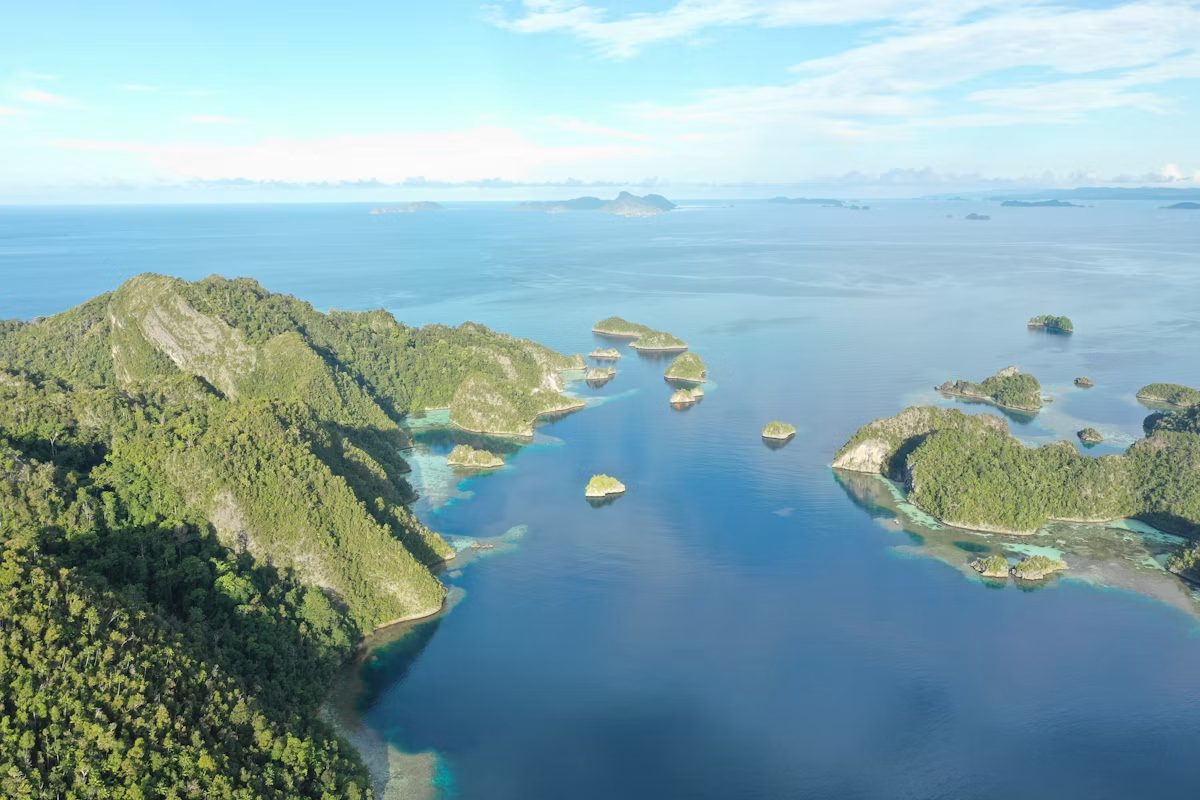
Pianemo Karst Panorama & Arborek Manta Expedition
Climb to the Pianemo viewpoint overlook and snorkel with reef manta rays at Arborek village.
 adventure
📍 Raja Ampat
$212.41
adventure
📍 Raja Ampat
$212.41
Wayag Cathedral Karst Lagoon & Shark Bay Boat Expedition
Scale the iconic karst pinnacle of Wayag 2 and swim with blacktip reef sharks in shallow turquoise bays.
 adventure
📍 Ubud
$36.33
adventure
📍 Ubud
$36.33
Mount Batur Sunrise Summit Trek with Hot Springs
Pre-dawn summit ascent across volcanic basalt ridges to watch the sunrise above Lake Batur and Mount Rinjani, followed by restorative thermal hot springs.
Planning a Bali trip?
Explore current destination information, accommodation options, and events before you travel.
Related Travel News & Editorial Dispatches
Stay informed with latest field updates, regulatory notices, and luxury hospitality coverage across Bali and Beyond.
 📍 Raja Ampat
Raja Ampat Refines Marine Conservation Tariff to Fund Community Patrols and Coral Reef Protection
WAISAI, Southwest Papua - October 1, 2026 - The Raja Ampat Regency Government, in partnership with the Regional Public Service Agency for Marine Protected Area Management (BLUD UPTD Pengelolaan KKP Kepulauan Raja Ampat), has implemented key administrative refinements to its environmental tariff structure. The move aims to ensure direct, transparent allocation of visitor contributions toward Indigenous community patrols, anti-poaching enforcement, and marine ecosystem restoration across the world's most biodiverse coral archipelago.
 📍 Raja Ampat
Raja Ampat Strengthens Sea Patrols as Authorities Step Up Action Against Destructive Fishing
Raja Ampat, Southwest Papua - September 27, 2026
 📍 Raja Ampat
Raja Ampat's Manta Rays: More Than 3,000 Individuals Documented in Indonesia's Marine Paradise
Raja Ampat, Southwest Papua - September 27, 2026
 📍 Raja Ampat
Raja Ampat Turtle Poaching Case: Chinese National Named Suspect as Investigation Moves Forward
Authorities in Indonesia's Southwest Papua Province have named a Chinese national, identified by the initials WS, as a suspect in an alleged hunt for a protected hawksbill turtle inside the Raja Ampat conservation area.
 📍 Raja Ampat
Raja Ampat’s New Tourism Model: When Conservation Becomes the Core of the Visitor Economy
![Regional image]()
 📍 Munduk
Phu Quoc Bests Bali in Condé Nast’s 2026 Asia Island Ranking: Inside Vietnam’s Tourism Momentum and What It Means for Island Travel
Phu Quoc has captured first place in Condé Nast Traveler’s 2026 U.S. Readers’ Choice Awards while Bali ranked sixth; behind the headline lies Vietnam’s rapid surge in direct international flights, 60% foreign arrival growth, and critical lessons for mature island destinations.